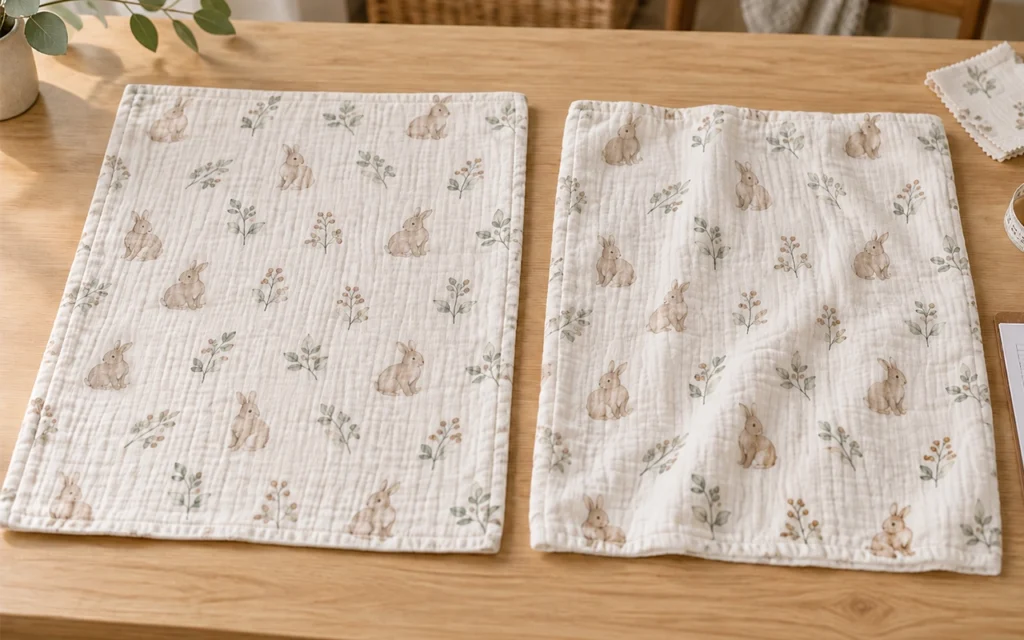
A sample can match the target dimensions perfectly when it leaves the sewing line, yet change noticeably after washing.
For baby textiles, this is not only a matter of losing a few centimeters. Shrinkage can affect product shape, symmetry, opening dimensions, the fit between coordinated pieces, and the overall user experience.
That is why brands developing swaddles, bibs, sleep sacks, blankets, or bedding should not check only the fresh sample dimensions.
Both pre-wash and post-wash measurements should be part of product development.
The Same Size on Paper May Not Stay the Same After Washing
A specification sheet only gives the starting dimensions.
For example, a swaddle may be designed at 120 × 120 cm, but different fabrics can react differently after washing and drying.
Several factors may influence the final dimensions:
• Fabric construction
• Fiber composition
• Woven or knitted structure
• Fabric weight
• Number of layers
• Washing method
• Drying method
As a result, two products made from the same paper pattern may not have the same post-wash size if the materials differ.
For buyers, this means cutting dimensions alone are not enough.
The actual finished sample should also be checked after the recommended care process before the final specification is confirmed.
Shrinkage Affects Different Baby Products in Different Ways
Shrinkage does not create the same problem for every product category.
Swaddles and Blankets
For larger textile products, the most visible change is usually in overall length and width.
If a brand wants the product to remain close to its target finished size after washing, the actual dimensional change needs to be evaluated during development.
Multi-layer muslin products also require another check: whether all layers shrink evenly.
If one layer behaves differently from another, the finished product may twist, wrinkle, or develop uneven edges.
Baby Bibs
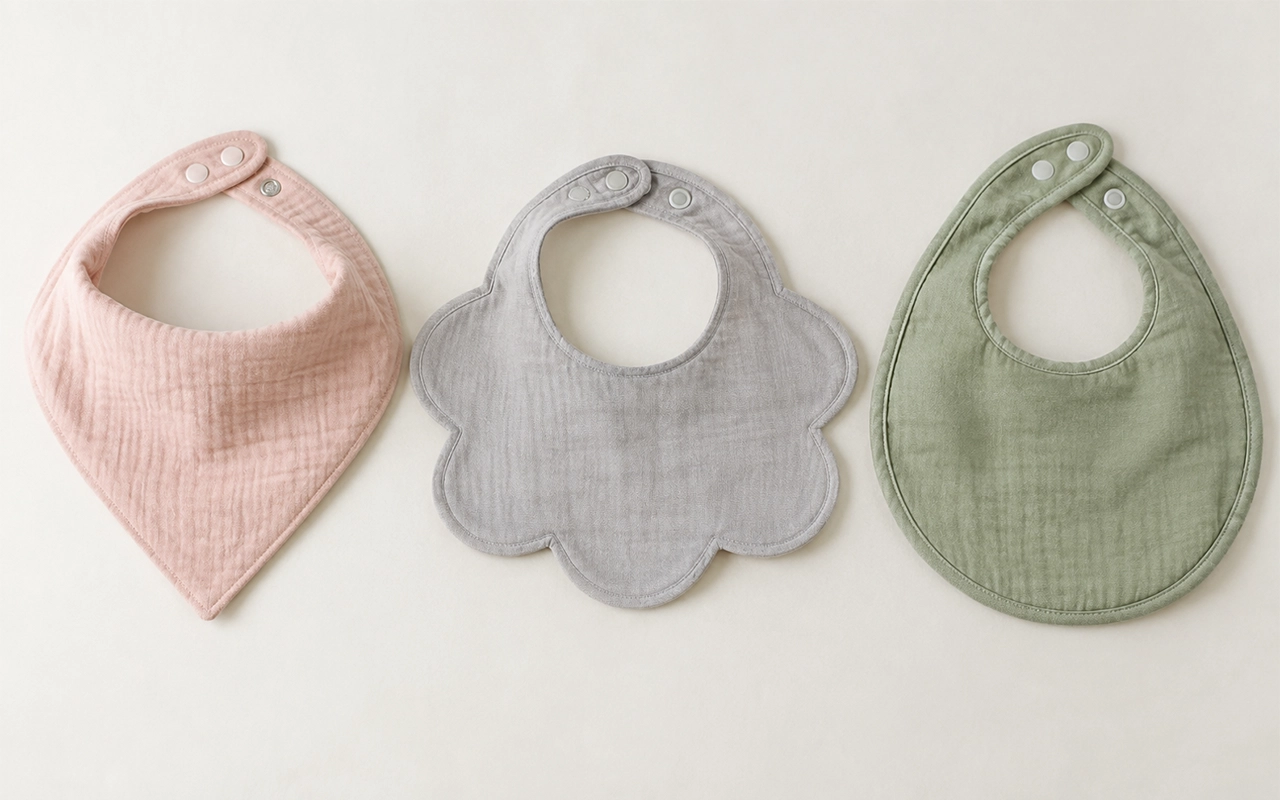
Bibs are smaller, but their shape can be more sensitive to dimensional changes.
Shrinkage may affect:
• Neck opening
• Overall width and length
• Symmetry
• Curved edges
• Layer alignment
This becomes especially important when a bib combines several different materials.
The outer layer, absorbent layer, and backing may not react in exactly the same way after washing.
Sleep Sacks
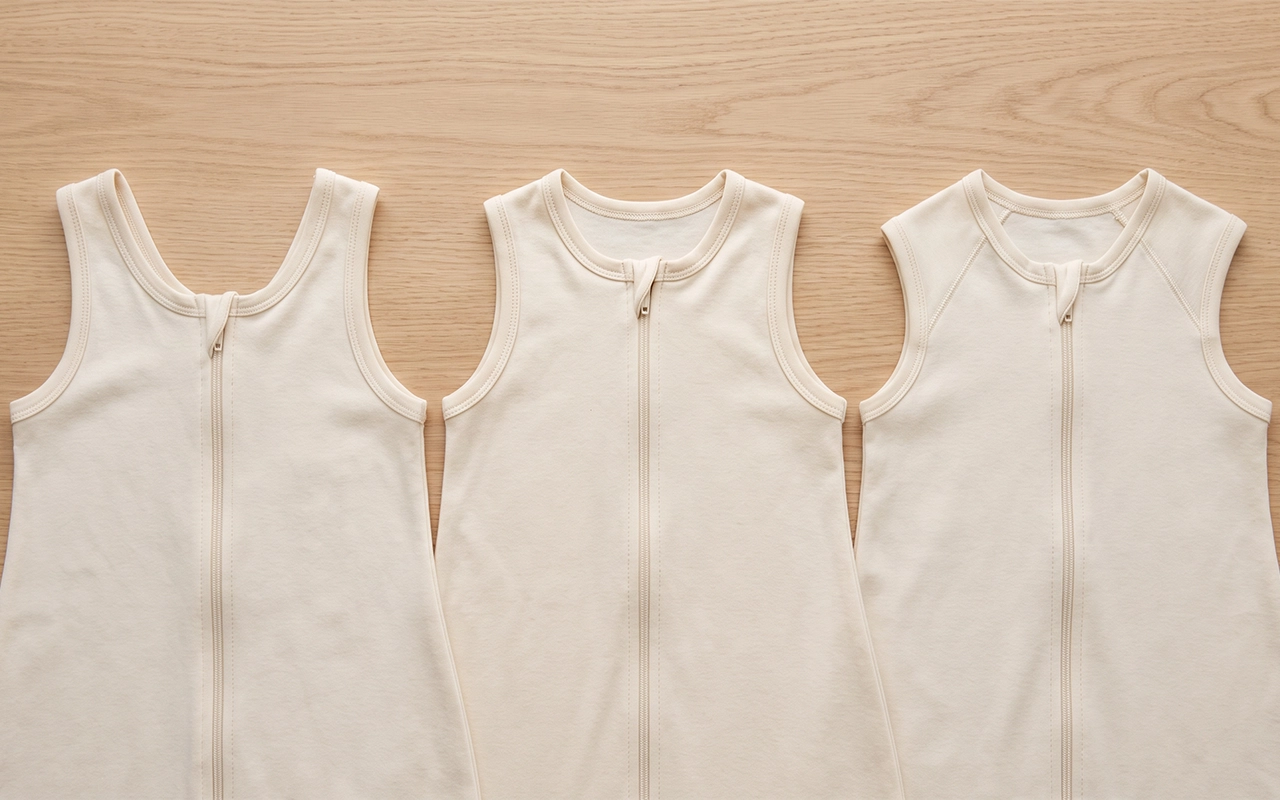
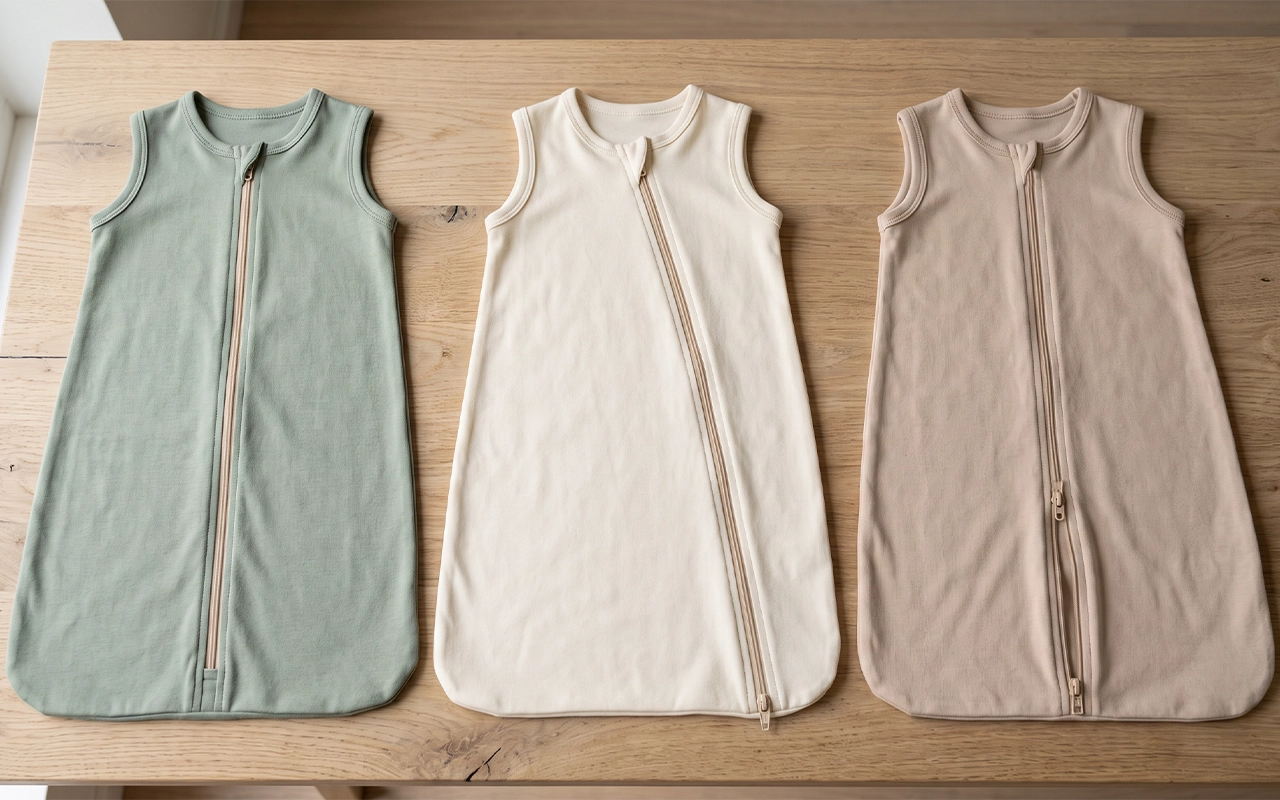
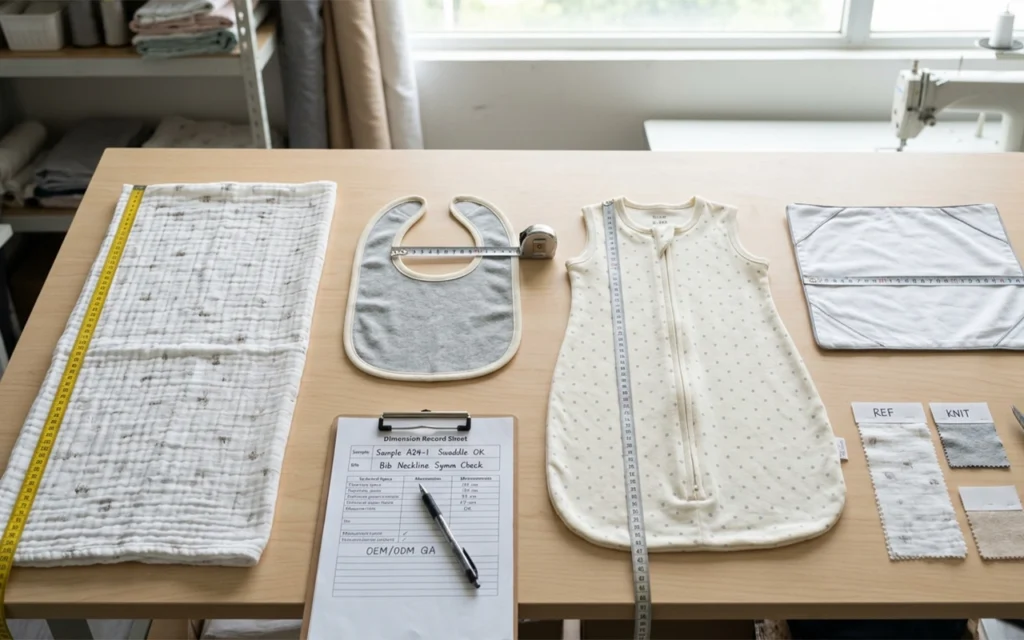
A sleep sack has a garment-like structure, so dimensional changes can affect several key areas at once.
Buyers may need to review:
• Overall length
• Chest width
• Neckline
• Armholes
• Bottom width
• Zipper area
Therefore, checking only the total length is not enough.
The proportions of the main construction areas should also remain consistent after washing.
Bedding Products
Pillowcases, duvet covers, and other bedding products have another issue: they need to fit related inner products.
If the outer cover shrinks too much, it may no longer match the pillow inner, quilt inner, or other intended insert correctly.
For bedding development, post-wash dimensions should therefore be considered together with the dimensions of the coordinated inner products.
Different Fabric Structures Can Behave Differently
A label that says “100% cotton” does not tell buyers exactly how much a fabric will shrink.
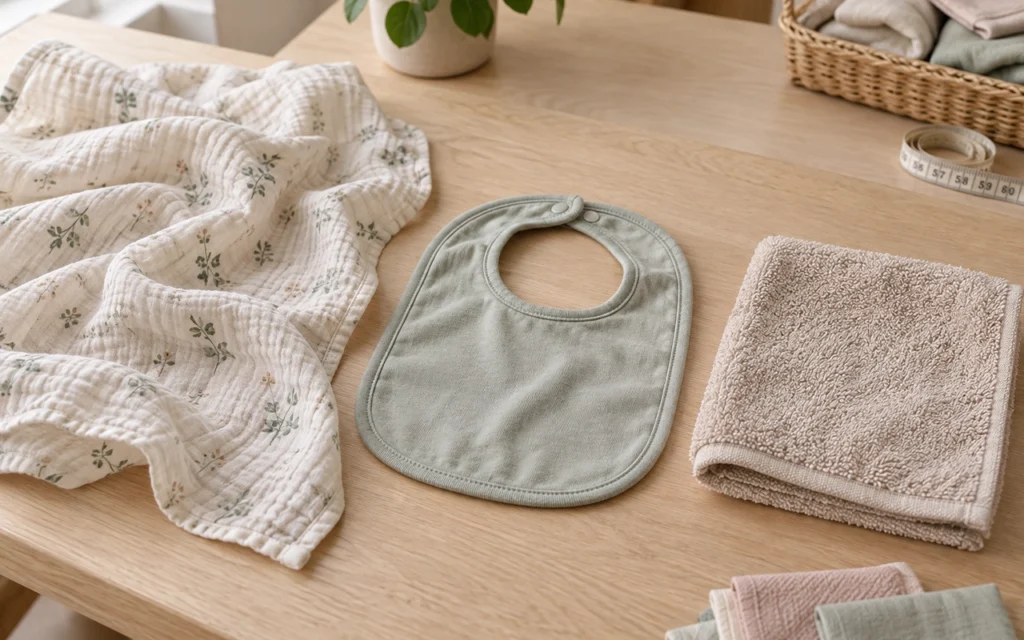
Muslin, knitted cotton, terry cloth, and other textile structures can behave differently even when the fiber composition is similar.
Results may also vary because of:
• Fabric density
• Yarn structure
• GSM
• Finishing process
• Layer construction
For this reason, shrinkage data from one product should not automatically be applied to another.
A more reliable approach is to evaluate the actual fabric and construction planned for the final product.
This becomes even more important with multi-layer products.
If the outer fabric, middle layer, and backing material are different, the finished item should be tested as a complete structure rather than judging only one fabric layer.
Check Both Measurements and Shape After Washing
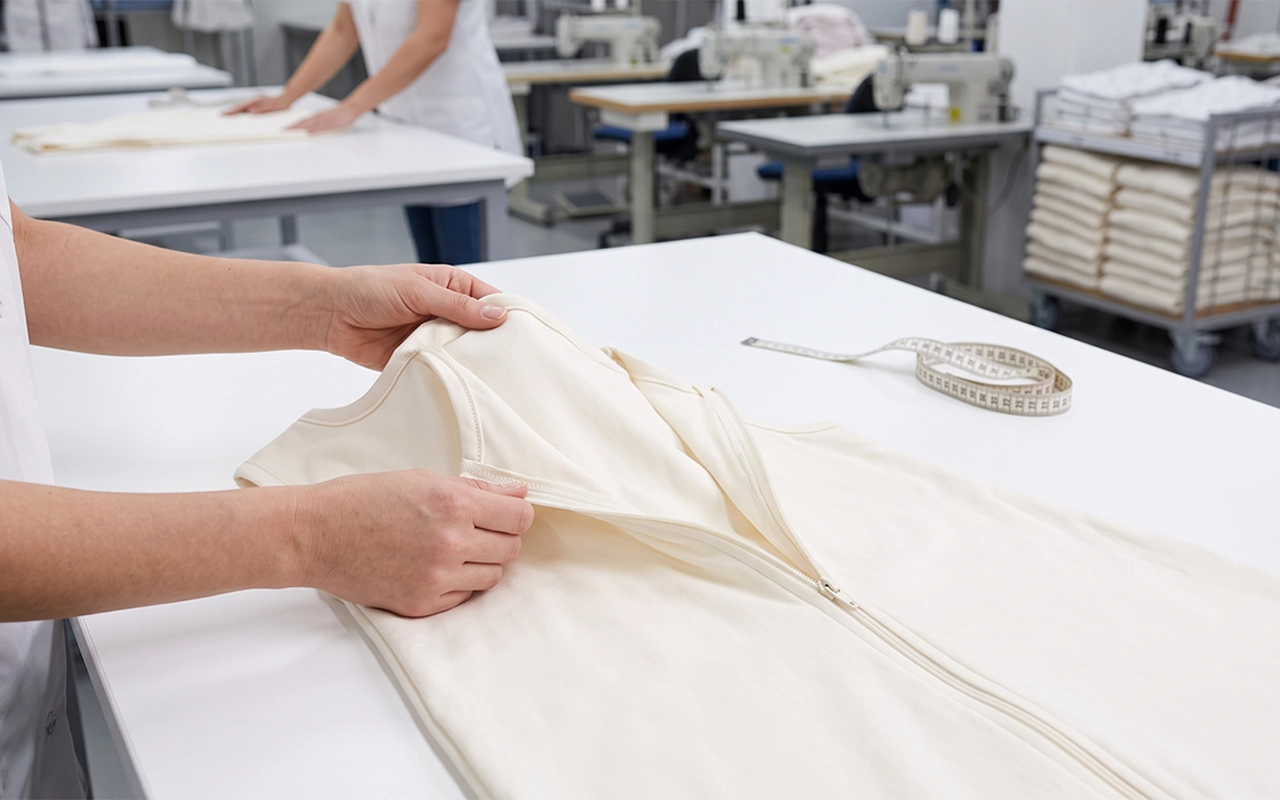
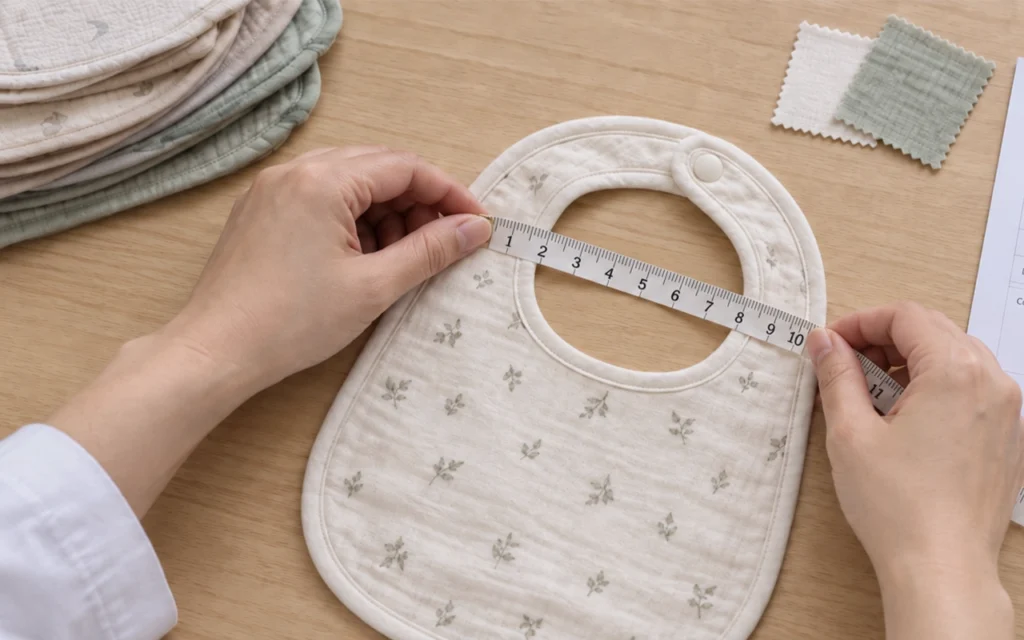
A post-wash inspection should involve more than measuring length and width.
Dimensions are only one part of the result.
A practical sample check can include:
• Pre-wash dimensions
• Post-wash dimensions
• Length and width changes
• Shape distortion
• Seam movement
• Edge changes
• Layer alignment
• Zipper or opening position
For example, a bib may remain close to its target width and length but become visibly asymmetrical.
A blanket may still fall within the expected dimensions, yet develop wavy edges or shifting between layers.
Therefore, measurement and appearance should be reviewed together.
This gives buyers a clearer picture of how the product behaves after normal care.
Shrinkage Should Be Considered Before Mass Production
Shrinkage problems are much harder to correct after bulk production has already begun.
For that reason, they should be addressed during sampling.
A simple development flow can look like this:
Target finished size
↓
Fabric and structure selection
↓
Sample production
↓
Wash test
↓
Measurement and adjustment
↓
Final specification
If the post-wash dimensions move too far from the target, the pattern, cutting size, fabric choice, or construction may need to be adjusted.
Brands and manufacturers should also confirm size tolerances, care methods, and acceptance standards before mass production.
The goal is not to guarantee that every textile shows zero dimensional change.
The goal is to understand and control that change within an agreed range.
Conclusion
Fabric shrinkage may look like a small material detail, but it can affect the entire product development result.
Swaddles and blankets may change in overall size. Bibs may lose symmetry or change around the neckline. Sleep sacks need careful checks around the neckline, armholes, body length, and zipper area. Bedding covers must continue to match their intended inner products.
For buyers, the development process should therefore consider more than the dimensions of a fresh sample.
A better approach is to review:
Fabric + Product Structure + Care Method + Pre/Post-Wash Measurements
Inorange Baby can support adjustments to fabrics, dimensions, layer structures, and product construction during sample development, helping brands refine specifications before mass production.