A baby sleep sack can look well made at first glance, yet small problems around the neckline or armholes can quickly affect the finished fit and appearance.
These areas sit close to the upper body, so proportion matters. An opening that is too wide, too narrow, too high, or poorly finished can make the whole garment look unbalanced.
For buyers developing sleep sacks, neckline and armhole construction should be reviewed as carefully as the zipper, fabric, or TOG level.
The Neckline Defines the Upper Fit
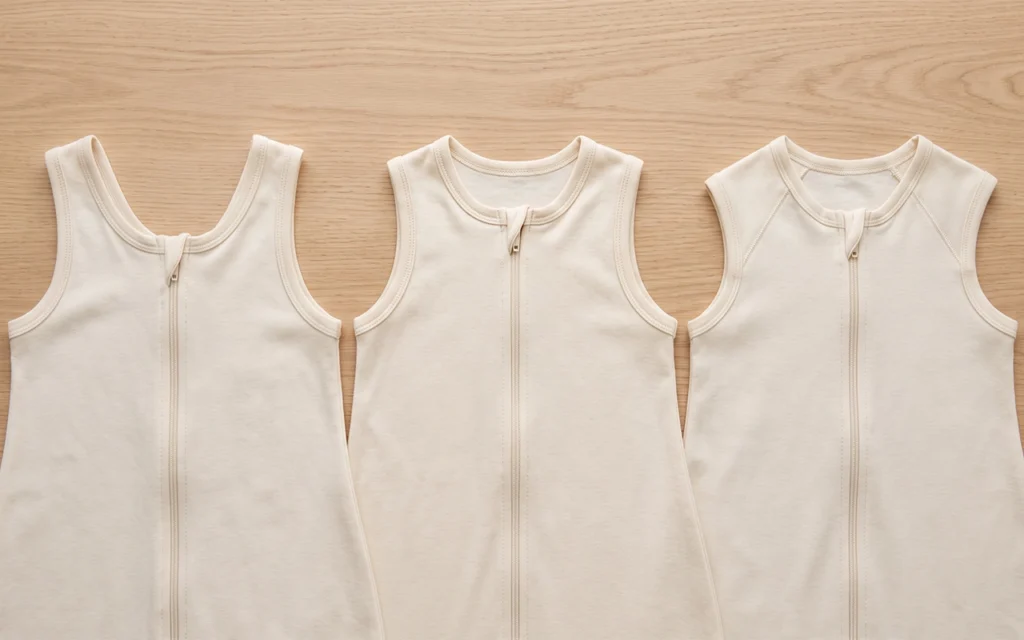
The neckline is one of the first areas to check during sample development.
Its shape and size affect how the upper part of the sleep sack sits around the neck and shoulders.
Buyers may need to review:
• Neck opening width
• Neck opening depth
• Front and back neckline shape
• Binding width
• Left-right symmetry
• Distance from zipper top
• Finished shape after washing
A neckline that looks correct on a flat technical drawing may still appear too open or too tight once the garment is sewn.
For this reason, the finished sample should be checked as a three-dimensional product rather than only against pattern measurements.
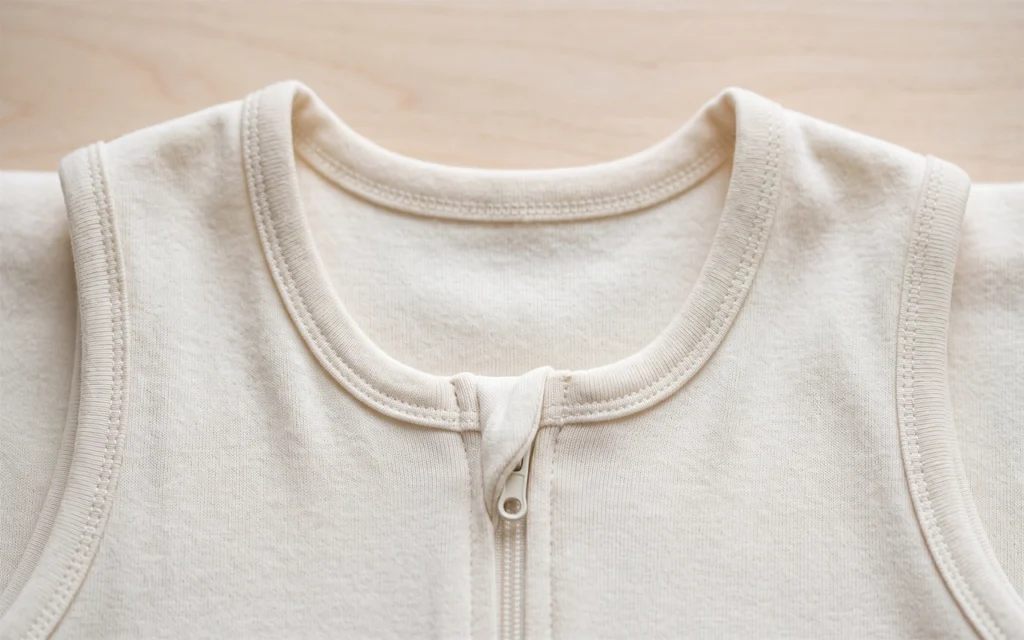
Armhole Size Affects Movement and Product Balance
Armholes need enough space for movement, but they should still match the overall garment proportion.
If the armhole is too small, the upper section can look restrictive.
If it is too large, the sleep sack may lose its intended fitted shape around the upper body.
The armhole also affects the transition between the shoulder and side seam.
Buyers can review:
• Armhole height
• Armhole depth
• Front curve
• Back curve
• Shoulder width
• Side seam position
These measurements should work together.
Changing only one area can alter the balance of the whole upper panel.
Different Sizes Need More Than Simple Scaling
A sleep sack size range cannot always be developed by enlarging every measurement by the same percentage.
As the garment size changes, the relationship between neckline, shoulder width, armhole depth, and body length may also need adjustment.
For example, a larger size may require:
• A wider neck opening
• More shoulder width
• A deeper armhole
• More room through the upper body
However, these changes still need to preserve the intended silhouette.
This means grading should be reviewed as part of product development rather than treated as a purely mathematical enlargement.
Binding Changes the Look of the Neckline and Armholes
Binding does more than finish a raw edge.
It can affect how the neckline and armholes hold their shape.
A soft, flexible binding can follow curves naturally.
A binding that is too stiff may cause the edge to stand away from the body or create visible tension.
Buyers should check:
• Binding material
• Binding width
• Stretch
• Stitching
• Color
• Edge consistency
The binding should remain smooth without twisting, puckering, or pulling the surrounding fabric.
Color can also be used as a design detail.
Matching binding creates a clean appearance, while contrast binding can connect with zipper color, embroidery, or other collection elements.
Neckline and Armholes Need to Stay Symmetrical
Symmetry is especially visible in the upper part of a sleep sack.
If one armhole sits higher than the other, or one side of the neckline curves differently, the entire product can look poorly balanced.
During sample inspection, buyers should compare:
• Left and right armholes
• Shoulder length
• Neckline curves
• Binding width
• Stitching position
• Zipper alignment
Laying the sleep sack flat can help reveal visible differences.
However, the garment should also be checked after washing because fabric movement can affect the final shape.
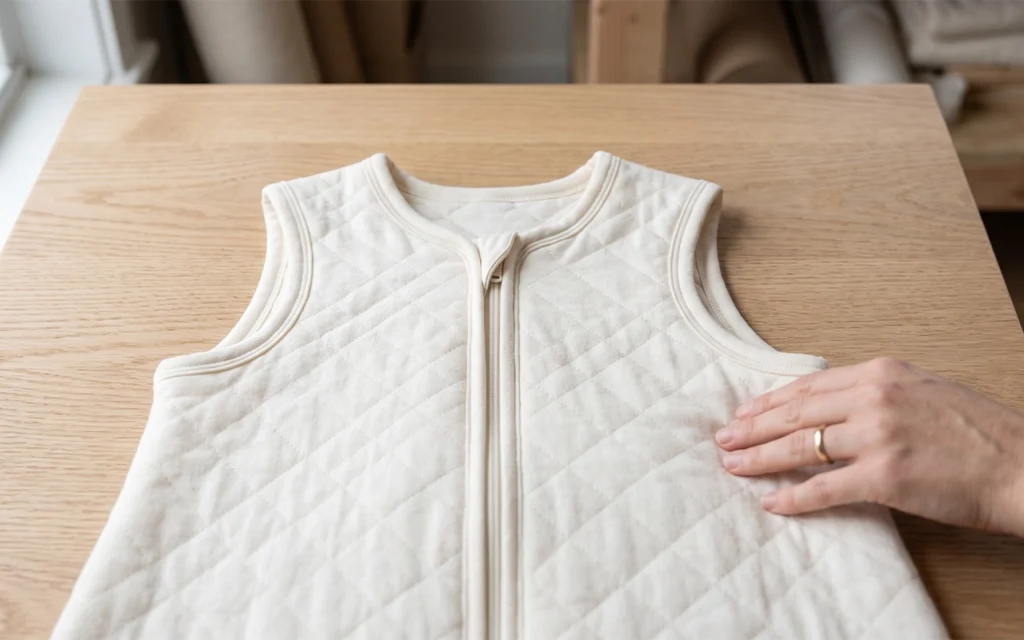
Fabric Stretch Changes Construction Behavior
Soft knitted fabrics can behave differently from more stable woven fabrics.
Stretch can influence:
• Neckline shape
• Armhole shape
• Binding tension
• Stitching
• Recovery after sewing
• Final dimensions
If the binding or stitching applies too much tension, the edge can become wavy.
If there is too little control, the opening may stretch out of shape.
Therefore, the same neckline pattern may not behave identically across different fabric constructions.
Material choice and upper-body construction should be tested together.
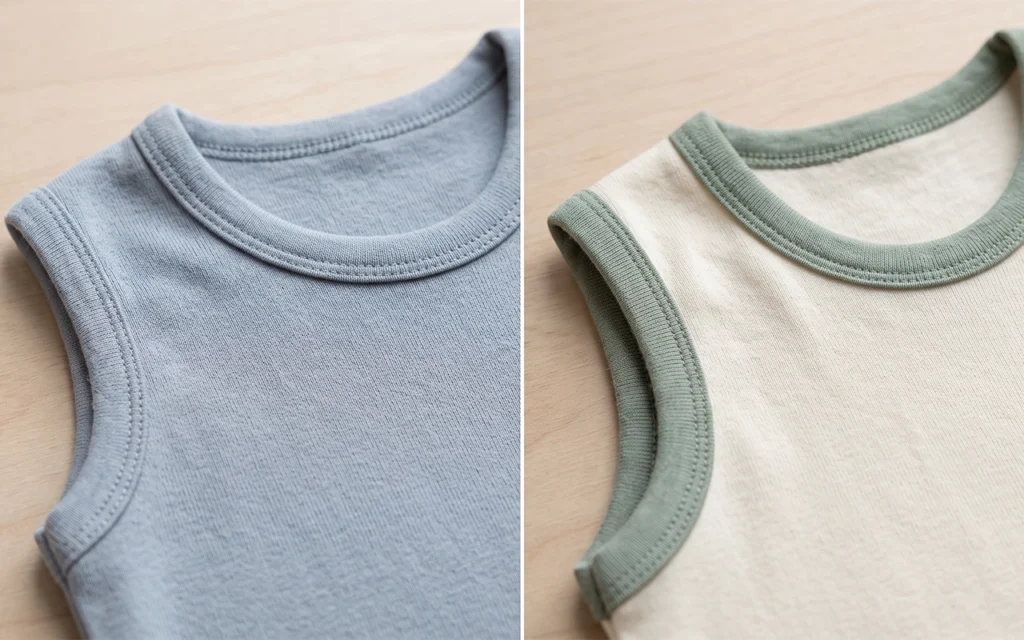
The Zipper and Neckline Need to Be Developed Together
The zipper sits very close to the neckline, so the two areas should not be developed independently.
The zipper top, zipper guard, and neckline binding all need enough space to work together cleanly.
Buyers should check whether:
• The zipper finishes at the correct height
• The zipper guard covers the pull properly
• Binding remains smooth beside the zipper
• The neckline stays symmetrical
• The upper front panel does not bunch or twist
A small change in zipper position can affect the neckline shape.
Likewise, changing the neckline depth may require the zipper length or zipper guard to be adjusted.
Sample Review Should Focus on the Upper Construction
During sampling, the upper section deserves its own inspection.
A useful review can include:
• Neck opening dimensions
• Armhole dimensions
• Shoulder width
• Binding consistency
• Symmetry
• Zipper position
• Stitching
• Post-wash shape
Inorange Baby can support custom sleep sack development with different necklines, armhole shapes, fabric options, TOG levels, zipper systems, binding colors, prints, embroidery, labels, and packaging.
These details can be adjusted together during sampling so the upper structure matches the intended product specification.
Conclusion
Neckline and armhole design can change the entire upper structure of a baby sleep sack.
The neckline affects proportion.
The armholes affect movement and silhouette.
Binding affects edge stability.
Fabric stretch affects how the construction behaves.
For buyers, the most useful development approach is to review:
Neckline + Armhole + Shoulder + Binding + Fabric + Zipper
as one connected system.