The Canton Fair is an important opportunity for international buyers to explore suppliers, discover products, and develop new business relationships. For baby brands and textile importers, the third phase offers several relevant product categories.
The 140th Canton Fair Phase 3 runs from October 31 to November 4, 2026. Its official exhibition categories include children, baby and maternity products, home textiles, and textile raw materials and fabrics. These categories make the event relevant to buyers exploring baby textile sourcing and product development.
However, finding a suitable supplier requires more than collecting business cards or product catalogs. Buyers need to understand material specifications, customization options, minimum order quantities, quality requirements, and production capabilities.
This guide explains how to prepare for Canton Fair Phase 3 and turn initial supplier contacts into practical baby textile development opportunities.
What Can Baby Textile Buyers Find at Canton Fair Phase 3?
Canton Fair Phase 3 covers several categories related to the baby and textile industries.
These include children, baby and maternity products, home textiles, and textile raw materials and fabrics. Buyers can explore these categories to understand the available product range and identify potential sourcing opportunities.
For baby textile businesses, relevant interests may include:
- Baby bedding and textile accessories
- Baby blankets and muslin products
- Bibs and feeding textiles
- Bath towels and washcloths
- Cotton fabrics and other textile materials
- Customized textile products for private-label collections
Not every supplier will offer the same product range. Some focus on finished goods, while others specialize in fabrics, components, or manufacturing services.
Therefore, buyers should identify their sourcing priorities before visiting the exhibition or contacting suppliers online. The officialCanton Fair exhibition informationprovides the current dates and product categories.
Prepare Your Sourcing Requirements Before the Fair
A clear sourcing brief makes supplier communication more efficient.
Before contacting manufacturers, buyers should decide which products they want to develop and what the finished products need to achieve.
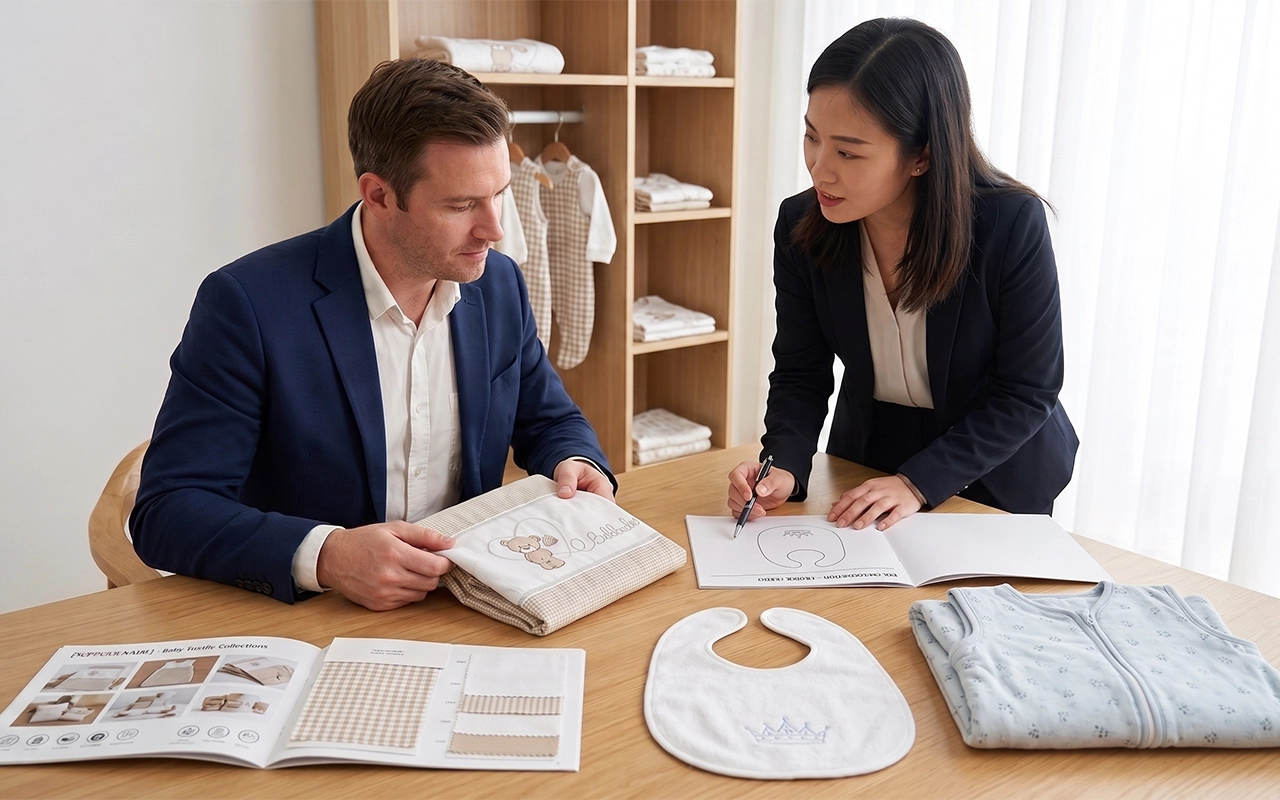
For example, a brand developing a new baby bedding collection may need to confirm fabric composition, dimensions, colors, print designs, and packaging requirements.
Meanwhile, a buyer looking for bibs may need to specify the outer fabric, absorbent layers, closure type, shape, and finished size.
Useful information to prepare includes:
- Product type and intended market
- Reference images or existing samples
- Fabric composition and preferred construction
- Product dimensions and target specifications
- Color, print, and embroidery requirements
- Target order quantity
- Required certifications or testing
- Packaging and labeling requirements
You do not need to finalize every detail before the first conversation. However, having a clear starting point helps suppliers understand your needs and identify the information they still require.
Understand the Difference Between a Supplier and a Manufacturer
Not every company offering baby textiles operates its own production facilities.
Some businesses manufacture products directly. Others focus on trading, sourcing, distribution, or brand management.
Neither model is automatically unsuitable. The important point is to understand what each supplier can provide.
If you need customized products, ask about the company’s role in product development and production.
For example, confirm whether the supplier can evaluate your reference sample, recommend suitable fabrics, develop prototypes, and coordinate production according to your specifications.
You should also ask how the company handles quality checks, material sourcing, and changes during development.
A manufacturer with relevant experience may offer more direct communication about construction, materials, and production feasibility. However, you should verify these capabilities rather than relying on a company description alone.
Ask the Right Questions About Customization and MOQ
Customization is an important consideration when developing a private-label baby textile collection.
A supplier may offer different options for fabric composition, GSM, colors, prints, embroidery, dimensions, and product construction. However, the available options depend on the product and the production requirements.
Minimum order quantities also vary.
For example, a standard fabric color may have different sourcing requirements from a custom-dyed color or an exclusive print. Special materials, additional layers, and complicated structures can also affect the minimum order quantity.
Before requesting a quotation, clarify:
- Can the supplier develop products from your artwork or technical pack?
- Can the supplier work from an existing physical sample?
- Which fabric and color options are available?
- Does the requested design require custom material production?
- What MOQ applies to each fabric, color, print, and product structure?
- Are sample development and production lead times available?
These questions help you compare suppliers on the same basis. They also reduce misunderstandings when a project moves from an initial discussion to sampling.
Evaluate Fabrics and Product Samples Carefully
A product photograph can help you understand the design, but it cannot fully communicate the actual material.
This is especially important for baby textiles. Two fabrics with similar appearances may have different weights, surface textures, stretch, absorbency, or washing performance.
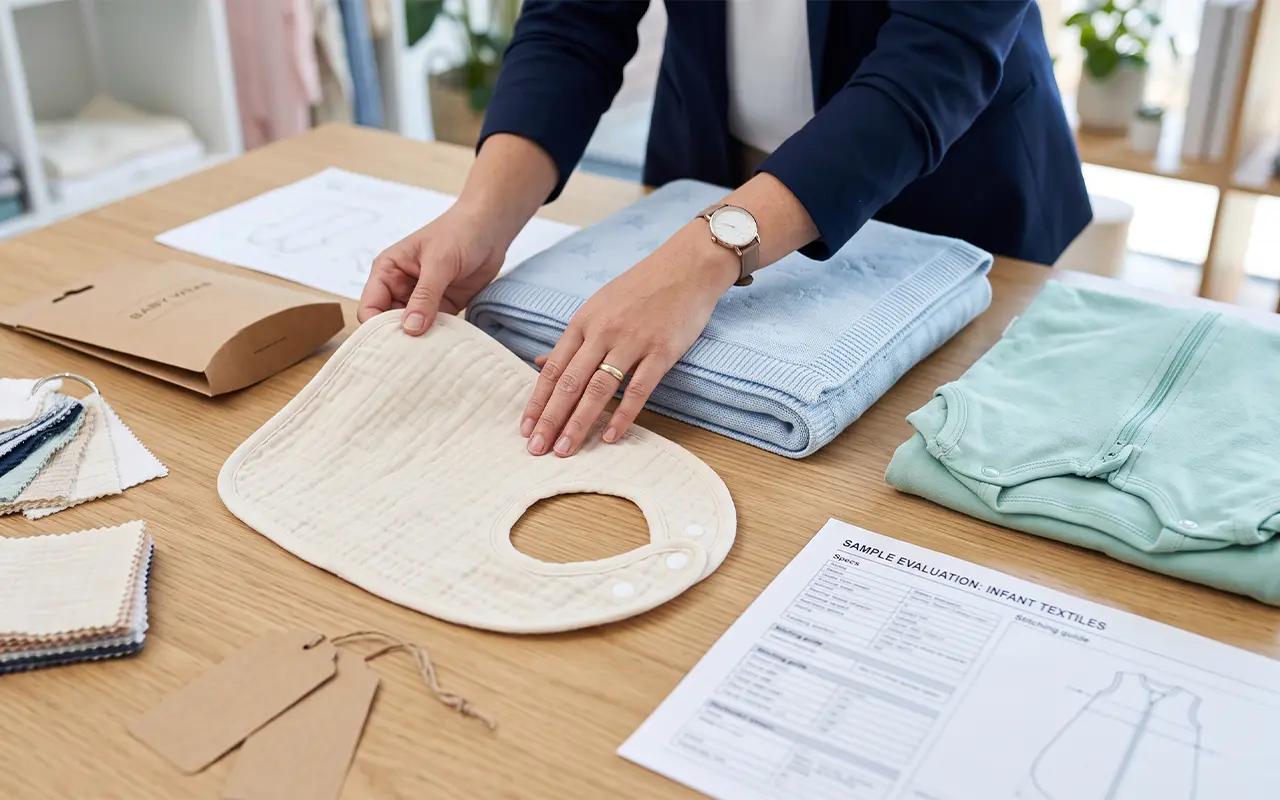
Whenever possible, request physical swatches or finished samples for evaluation.
For fabric selection, review:
- Fiber composition
- Weave or knit structure
- GSM and thickness
- Surface feel
- Print and embroidery appearance
- Shrinkage after washing
- Color stability
- Suitability for the intended product
For finished products, also check dimensions, stitching, closures, construction, and labeling requirements.
If your brand requires specific certifications or test reports, confirm their scope and relevance to the intended product and market. Do not assume that a fabric certificate automatically covers every finished product.
A structured evaluation helps you make a more informed decision than price comparison alone.
Compare Quotations on the Same Specifications
A lower quotation does not necessarily represent a better sourcing opportunity.
Two suppliers may quote different prices because they use different materials, constructions, packaging, or production methods.
Therefore, prepare a consistent specification before comparing offers.
For each quotation, check:
- Fabric composition and GSM
- Product dimensions and construction
- Color and print requirements
- Accessories and components
- Packaging and labeling
- Quoted quantity and applicable MOQ
- Sample costs
- Production lead time
- Delivery terms and payment conditions
If one quotation excludes certain components or packaging, record that difference clearly.
You can then compare the offers more accurately and identify which supplier best matches your product requirements.
In addition, keep track of unanswered questions. A supplier’s ability to explain technical details and clarify costs can be useful when evaluating a potential long-term manufacturing relationship.
Turn Supplier Contacts Into Product Development Projects
Collecting supplier contacts is only the beginning of the sourcing process.
After meeting a supplier or exchanging initial messages, organize the information while the discussion is still fresh.
Record the supplier’s product range, manufacturing capabilities, material options, MOQ, quotation status, and any outstanding questions.
Next, select the most relevant suppliers for follow-up.
Share your reference images, technical specifications, and target quantities. Then ask each shortlisted supplier to confirm feasibility and identify any missing information.
Once the specifications are clear, you can move toward quotation and sample development.
During sampling, review the product carefully and communicate any required adjustments. Confirm the final specifications before approving bulk production.
This process creates a clearer path from initial contact to a workable sourcing arrangement.
Working With a Baby Textile Manufacturing Partner
For brands developing customized baby textiles, a manufacturing partner should understand both the material requirements and the finished product.
Inorange Baby supports OEM, ODM, and private-label development across a range of baby textile products.
Depending on the project, buyers can discuss products such as bibs, blankets, bedding, bath textiles, sleep sacks, and other customized textile items.
Development can begin with a reference image, an existing sample, artwork, or a technical pack. The team can then assess the requested materials, construction, customization options, and production requirements.
MOQ depends on the specific fabric, color, print, structure, and order quantity. Therefore, the project details need to be reviewed before confirming a quotation.
If you are planning a new baby textile collection, visitInorange Babyto explore the company’s product range and manufacturing capabilities.
Conclusion
Canton Fair Phase 3 2026 provides a timely opportunity for international buyers to explore suppliers and sourcing opportunities across baby products, home textiles, and textile materials.
However, successful sourcing depends on more than finding a company with a suitable product photograph.
Prepare your requirements, ask specific questions, evaluate materials, compare quotations on consistent specifications, and establish a clear sample approval process.
Most importantly, choose suppliers whose capabilities match your product needs and long-term plans.
A well-prepared sourcing process helps turn initial supplier contacts into more productive product development discussions.