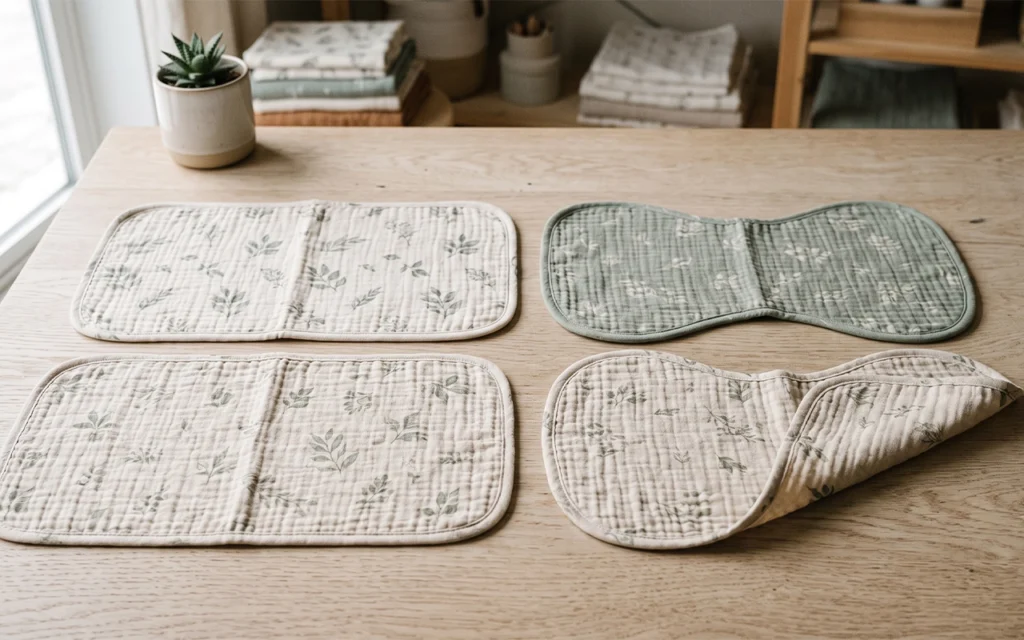
A burp cloth may seem like a simple textile product, but its shape can change how the entire item looks, feels, and fits into a brand collection.
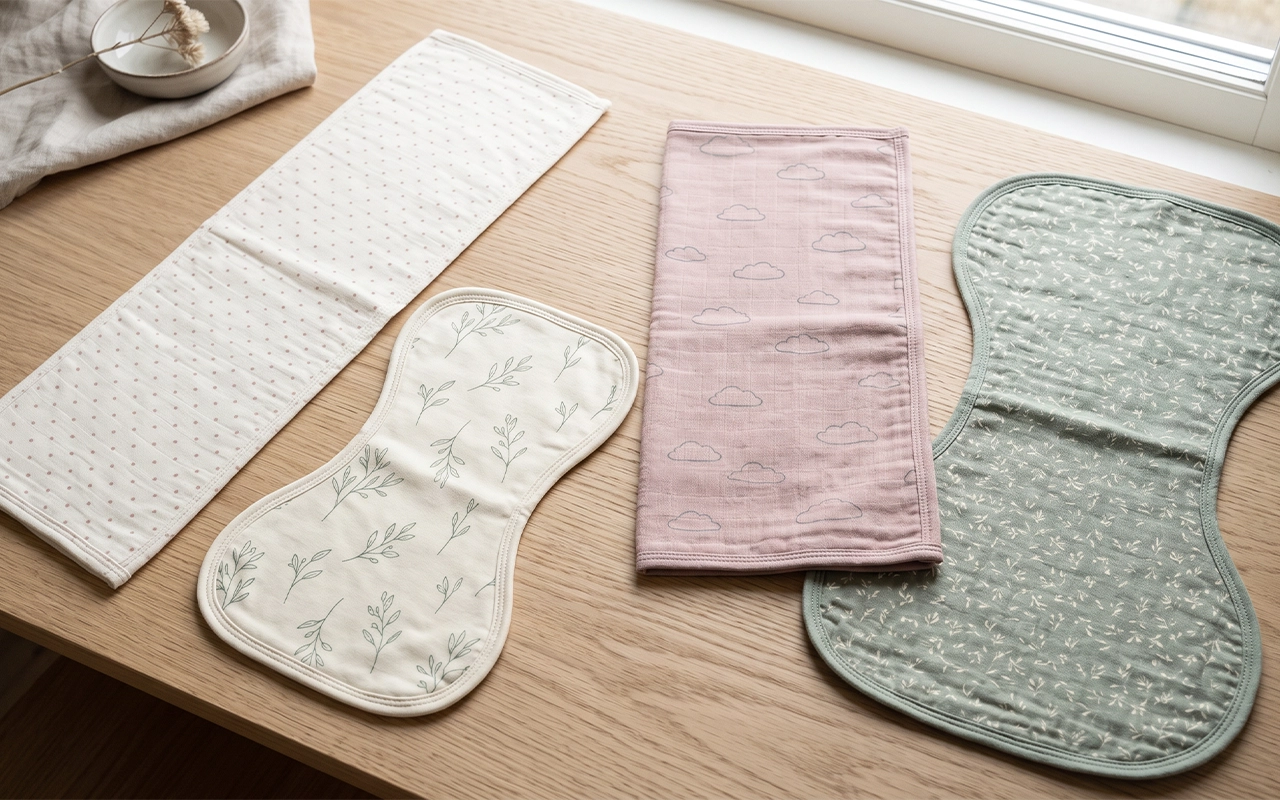
Some products use a basic rectangular shape. Others are curved or contoured to sit more naturally over the shoulder. Neither option is automatically better. The right choice depends on the intended use, product dimensions, fabric structure, print layout, and target positioning.
For buyers developing a new burp cloth range, shape should be treated as part of the product specification rather than a purely visual decision.
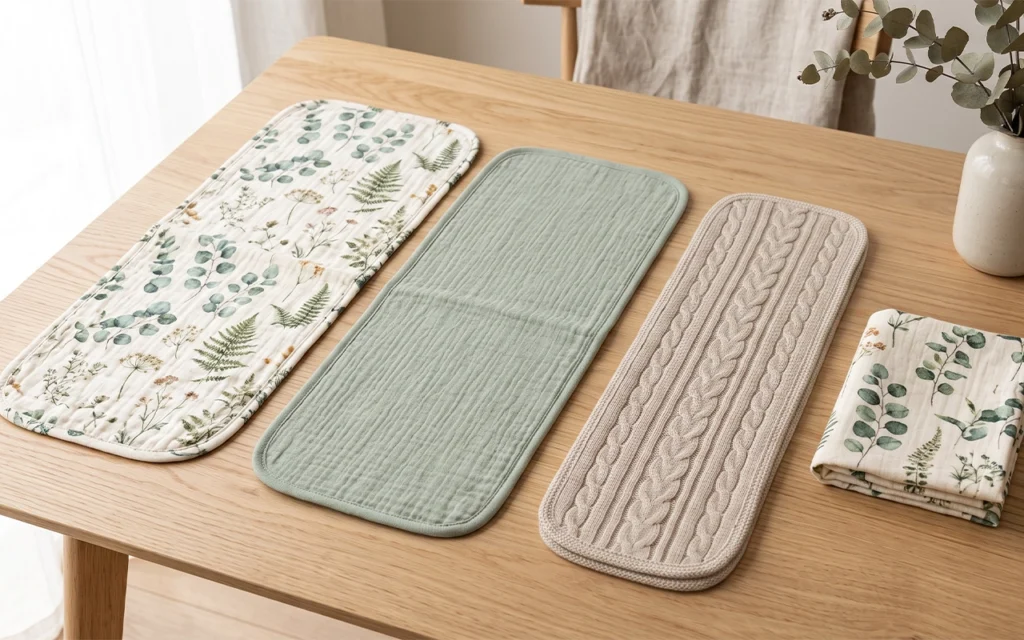
Rectangular Burp Cloths Offer a Simple and Flexible Structure
Rectangular burp cloths are one of the most straightforward product formats.
Their simple shape makes them easy to fold, stack, package, and coordinate with other baby textile products. They also provide a larger uninterrupted surface for prints, woven patterns, or solid-color designs.
This format can work well for brands that want:
• A clean and simple product shape
• Larger print areas
• Easy folding and storage
• Multi-piece packs
• Straightforward size development
Rectangular products can also support a wide range of materials, including muslin, knitted fabrics, terry cloth, jacquard fabrics, and layered constructions.
Because the outline is simple, more attention can be placed on fabric, GSM, layer structure, edge finishing, and print design.
For example, a rectangular muslin burp cloth may use an all-over animal print, while another version may use a solid fabric with a contrasting edge.
Contoured Shapes Create a More Defined Product Form
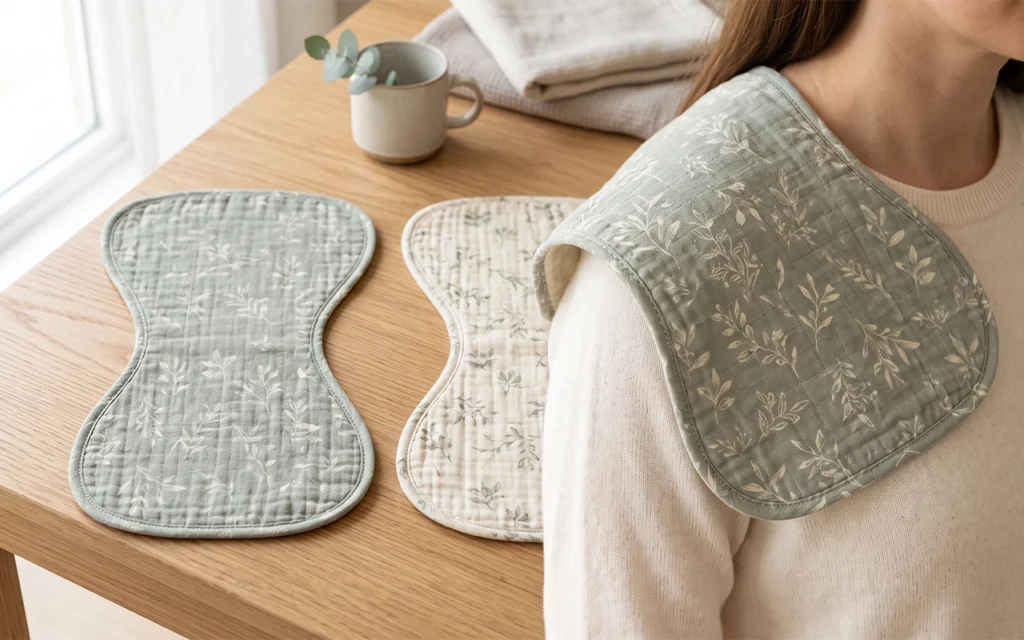
Contoured burp cloths use curved edges or a narrower center section to create a more shaped silhouette.
This format is often designed to sit more naturally around the shoulder area compared with a simple rectangle.
From a product development perspective, contoured shapes create more decisions around:
• Curve depth
• Shoulder coverage
• Center width
• Overall length
• Edge finishing
• Pattern placement
• Symmetry
The final shape also becomes a stronger visual feature of the product.
A contoured burp cloth may therefore suit brands that want the product itself to look more distinctive, even when the fabric is relatively simple.
However, curved shapes also require more attention during sampling. If cutting or sewing is inconsistent, the left and right sides may appear uneven.
Shape Changes How Prints and Patterns Appear
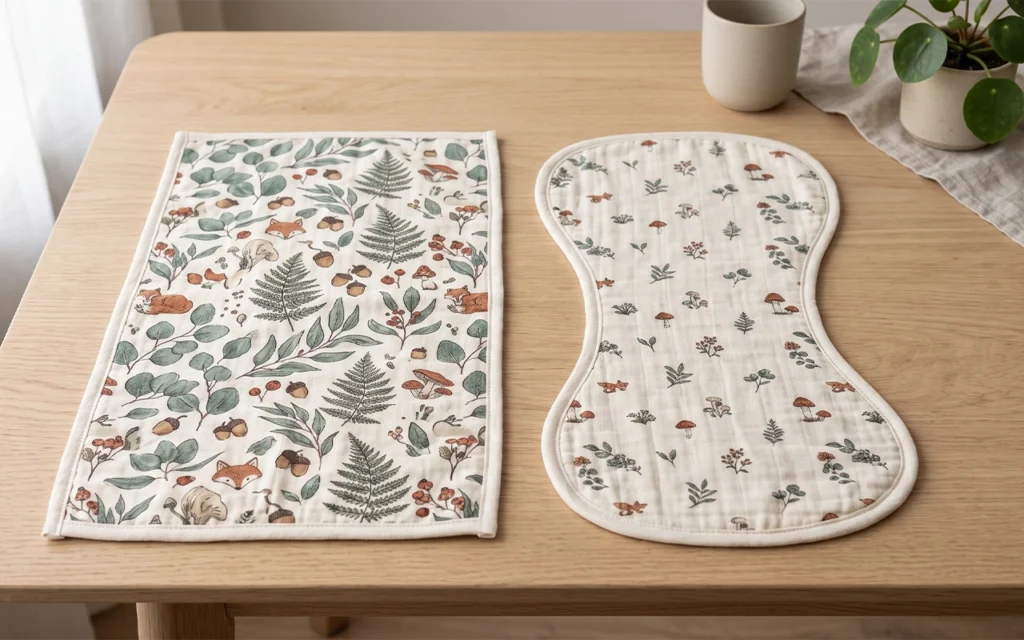
A print that works well on a rectangle may not work the same way on a contoured product.
Rectangular burp cloths provide a larger continuous area, so repeated prints are easier to position across the surface.
Curved shapes can create more challenges.
Important motifs may be cut off near the edges, or the narrow center section may make a large repeat look unbalanced.
For this reason, buyers should consider:
• Pattern scale
• Repeat size
• Motif placement
• Direction
• Cutting position
For example, a large animal print may work well on a rectangular style, while a smaller repeated pattern may suit a contoured design better.
This is another reason why shape and artwork should be developed together.
Edge Finishing Can Look Different on Each Shape
Burp cloth shape also affects edge finishing.
A rectangular product usually has straighter edges and corners, while contoured styles include more curves.
This can influence the choice of:
• Binding
• Merrow edge
• Standard stitching
• Decorative edge finishing
Curved sections require more control to keep the edge smooth and even.
If binding is too stiff, the product may not sit naturally around the curve. If a decorative edge is uneven, the shape can look distorted.
Therefore, edge finishing should be tested on the actual product shape rather than selected only from a fabric swatch or trim sample.
Size and Shape Should Be Planned Together
Shape cannot be separated from dimensions.
Two burp cloths may have the same overall length but provide very different coverage if one is rectangular and the other is contoured.
Buyers can compare:
• Overall length
• Maximum width
• Narrowest section
• Shoulder area
• Finished product weight
A wider rectangle may provide more overall fabric area. A contoured shape may concentrate the material around specific areas.
This means product size should not be judged from one number alone.
A complete specification should include both dimensions and the actual shape.
Which Shape Fits Different Product Positions?
A useful way to compare the two styles is by product positioning.
Rectangular Burp Cloth
• Simple and versatile
• Easy to fold and package
• Suitable for repeated prints
• Works well in multi-piece sets
• Flexible for different materials
• More distinctive silhouette
• Designed around shoulder placement
• Stronger product identity
• Requires more attention to curves and symmetry
• May need more careful print and edge planning
Some brands may even choose to offer both.
For example, a basic collection could use rectangular muslin burp cloths, while a premium or design-focused range could introduce contoured styles with different prints, edge details, or layered structures.
Customization Can Go Beyond the Shape
Once the base shape is chosen, the product can still be customized in many other ways.
Depending on the project, buyers can adjust:
• Material
• Number of layers
• GSM
• Product dimensions
• Prints
• Embroidery
• Edge finishing
• Labels
• Packaging
This means two rectangular burp cloths can still look completely different. The same is true for two contoured products.
Inorange Baby can support custom burp cloth development based on different shapes, dimensions, materials, layer structures, GSM, patterns, edge finishes, labels, and packaging. Existing products can provide a reference, while the final specification can be adjusted according to the intended collection.
Conclusion
Rectangular and contoured burp cloths serve different product directions.
Rectangular styles offer a simple structure, flexible print area, and easy packaging. Contoured styles create a more defined silhouette and require closer attention to curves, symmetry, and artwork placement.
For buyers, the right choice depends on more than appearance.
A better decision comes from considering:
Shape + Size + Fabric + Layer Structure + Pattern + Edge Finish
When these elements are planned together, the final burp cloth is more likely to match the intended product position.