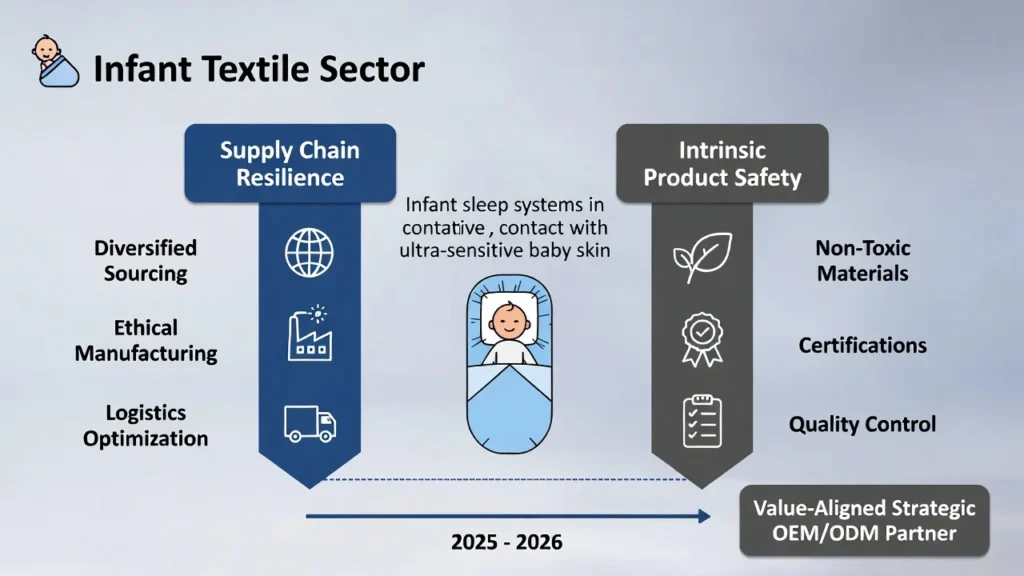
In the infant textile sector, supply chain resilience and intrinsic product safety have become the definitive pillars of long-term brand equity. For infant sleep systems—products in constant contact with a baby’s ultra-sensitive skin—we are no longer simply vetting a vendor; we are securing a value-aligned, strategic partner. Here are the four core dimensions we apply throughout the 2025-2026 cycle to identify elite OEM/ODM collaborators.
I. Compliance Deep Dive: Beyond Paper Certifications
Compliance is no longer merely an entry ticket; it has become the non-negotiable foundation of inherent safety and brand trust moat.
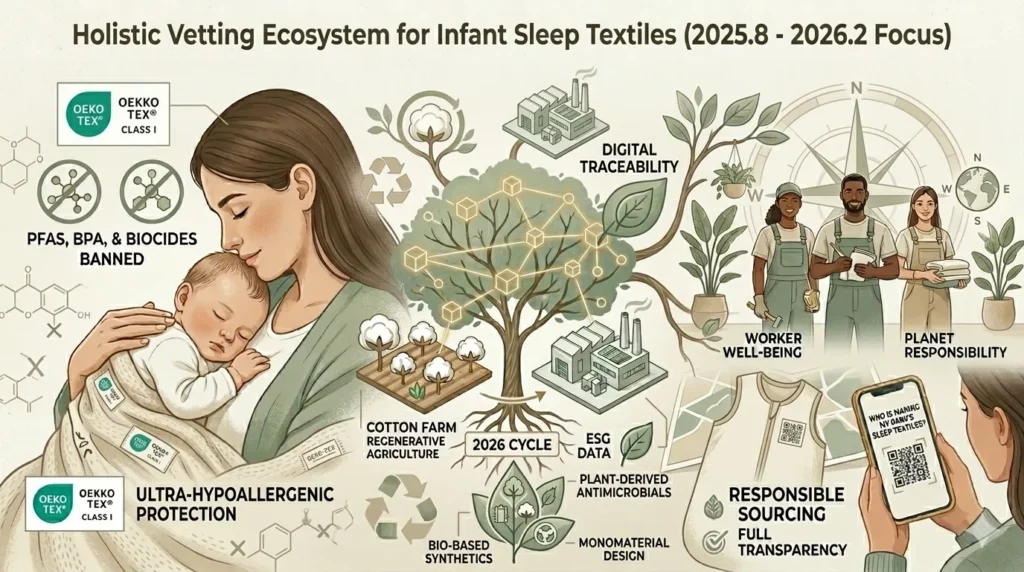
Chemical Zero-Harm (OEKO-TEX® Class I): The 2026 criteria now include strict bans on PFAS, BPA, and biocides. This meets the 2025–2026 parental priority for ultra-hypoallergenic protection for infant sleep textiles.
Regenerative Closed-Loop Traceability (GOTS 8.0): Utilizing digital/blockchain-enabled traceability, GOTS 8.0 (2026) emphasizes microfibre management and ESG disclosure. In 2026, non-sustainable = no-buy is a commercial imperative.
ESG 2.0 & Ethical Compliance: US and global parents demand to know: “Who is making my baby’s sleep textiles, and are they treating people and the planet responsibly?”
II. Physical Zero-Harm & Inherent Structural Safety: The Non-Negotiable Red Line
Physical hazards often remain hidden yet carry catastrophic — even fatal — risks for infants.
Automated Needle & Metal Fragment Detection:
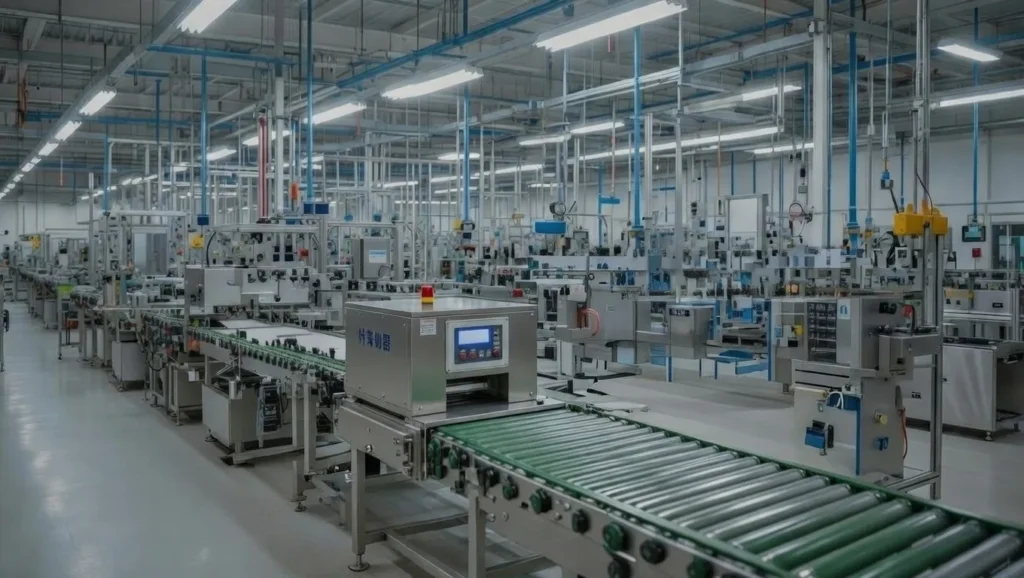
Qualified factories deploy conveyor-belt automated needle detectors (with full audit trails) to guarantee zero metal remnants — a core requirement under updated CPSIA/ASTM alignment.
Pull Strength & Small Parts Integrity (Choking Prevention):
Detachable elements must endure a sustained $90N$ pull test without failure. This directly counters choking hazards — a heightened parental priority in 2026, reinforced by ASTM F963 updates.
Proactive Strangulation-Free & Suffocation-Resistant Design:
Designs prioritize breathable, firm structures and no-loose-parts principle, aligning with 2026 CPSC/ASTM standards (e.g., F3735) for wearable sleep products.
III. R&D Innovation & Sustainable Craftsmanship: From OEM to Value-Aligned ODM
A top-tier supplier isn’t merely an executor of blueprints; they must evolve into a co-creator of solutions with regenerative & adaptive expertise.
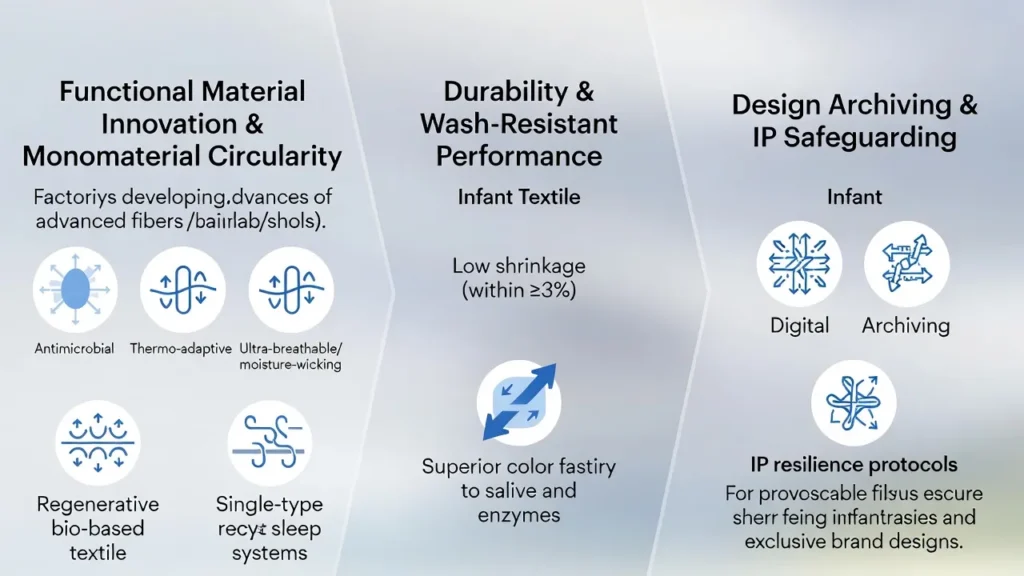
Functional Material Innovation & Monomaterial Circularity:
Do they possess capabilities to source or co-develop antimicrobial, thermo-adaptive, or ultra-breathable & moisture-wicking fibers? In 2026, leading partners prioritize regenerative bio-based textiles and Monomaterial Circularity (designing with single-type recyclable fibers) to meet the escalating global demands for closed-loop sustainability and hypoallergenic safety in infant sleep systems.
Durability & Wash-Resistant Performance (Shrinkage and Color Fastness):
Infant textiles face repeated high-intensity washing. Suppliers must maintain shrinkage within $\pm 3\%$ and deliver superior color fastness to saliva & enzymes. This aligns with 2025–2026 zero-harm longevity standards, meeting parental demands for sustainable, non-fading safety that withstands bio-enzymatic detergents.
Design Archiving & IP Safeguarding:
Robust digital archiving of patterns combined with a rigorous IP resilience protocol ensures your brand’s innovations stay exclusive and secure. In an era of value-aligned collaboration, traceable IP integrity is a non-negotiable pillar for protecting original designs in the global marketplace.
IV. Agility & Full-Chain Transparency: The Resilience Imperative
In an uncertain market, real-time sync and supply chain agility have become the cornerstones of sustained success in infant textiles.
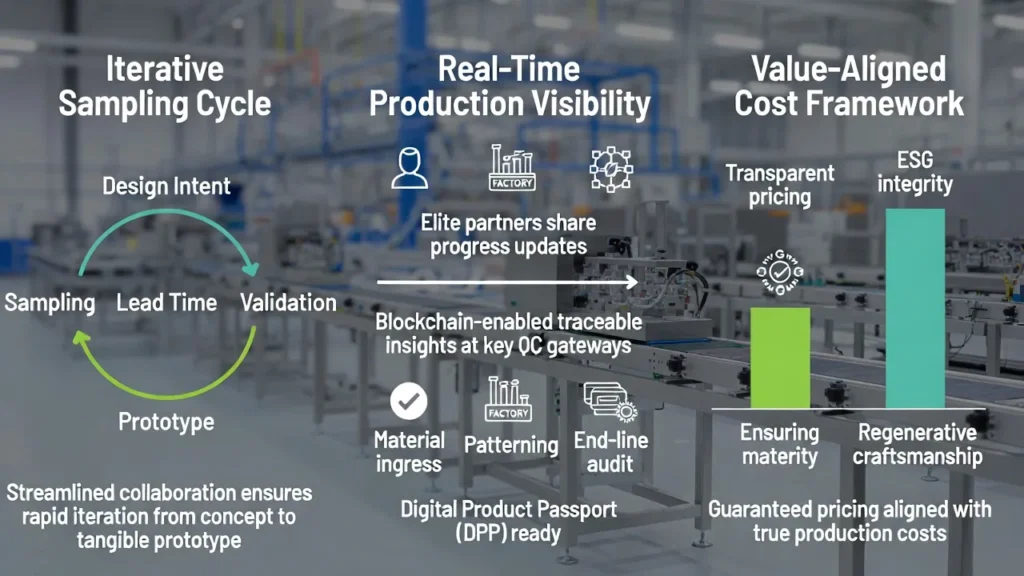
Iterative Sampling Cycle (Rapid Prototyping Loop): Monitor the lead time from design intent to tangible prototype. Streamlined collaboration significantly accelerates Time-to-Value, aligning with 2026’s emphasis on agile co-creation for hypoallergenic sleep systems.
Real-Time Production Visibility (Digital Milestone Tracking & DPP Readiness): Elite partners actively share progress updates and deliver blockchain-enabled traceable insights at key QC gateways (material ingress, patterning, end-line audit). This guarantees Digital Product Passport (DPP) readiness, a must for zero-disruption resilience and securing global parental trust in 2025–2026.
Value-Aligned Cost Framework (Transparent Pricing & ESG Integrity): Steer clear of unsustainable low bids. Demand cost visibility & breakdown to confirm every investment fuels material integrity, regenerative craftsmanship, and verifiable ESG / Scope 3 data, ensuring long-term sustainability without compromising inherent safety.