It’s More Than Just Catching Drool: The First Line of Defense for Your Baby’s Skin
Sobald Bestellungen bei uns eingehen, kommissioniert unser Team die Produkte sorgfältig und stellt sicher, dass die richtigen Artikel und Mengen ausgewählt werden. Diese Liebe zum Detail ist entscheidend für die Aufrechterhaltung der Kundenzufriedenheit.
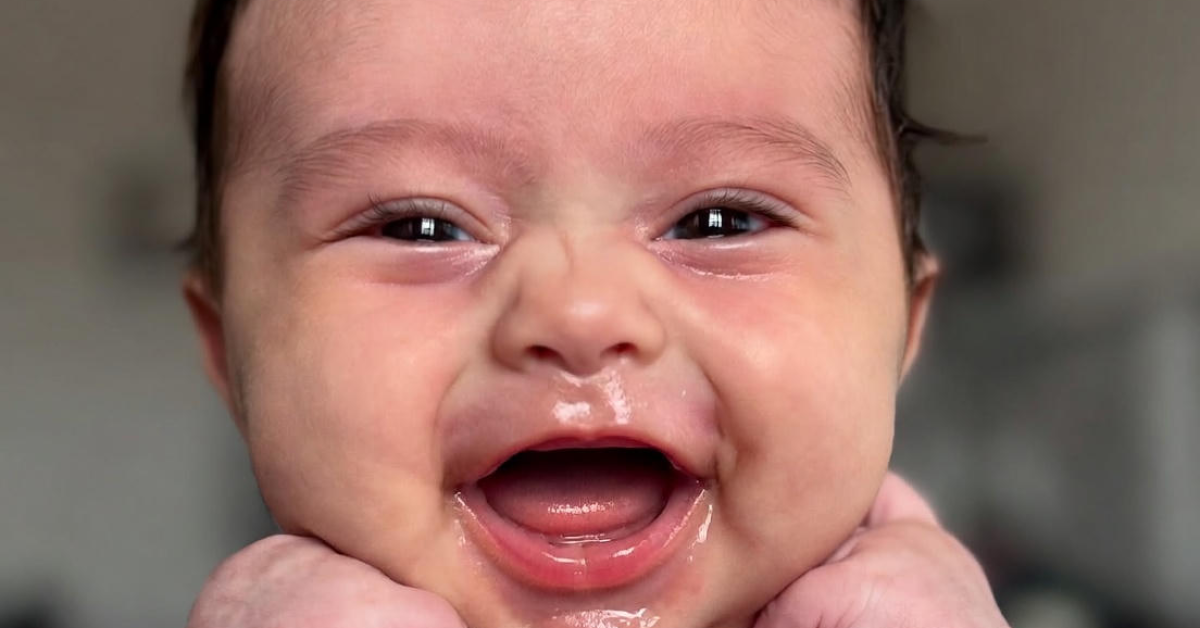
For many new parents, a baby bib might seem like a simple, disposable accessory. But once the teething phase hits—when you find yourself changing 8 to 10 bibs a day and noticing that angry red drool rash appearing on their chin—reality sets in. We quickly realize that a bib is more than just a shield for clothes; it is the critical first line of defense for your baby’s delicate neck skin.
In our 【Ingredient Breakdown】 column, we look past the cute patterns to focus on the essence: the material itself. Today, we are putting the market’s most common bib fabrics into our ‘analysis room’ to evaluate their true performance in absorbency, breathability, and skin-friendliness.
Breaking Down the Mainstream "Ingredients": A Fabric Comparison
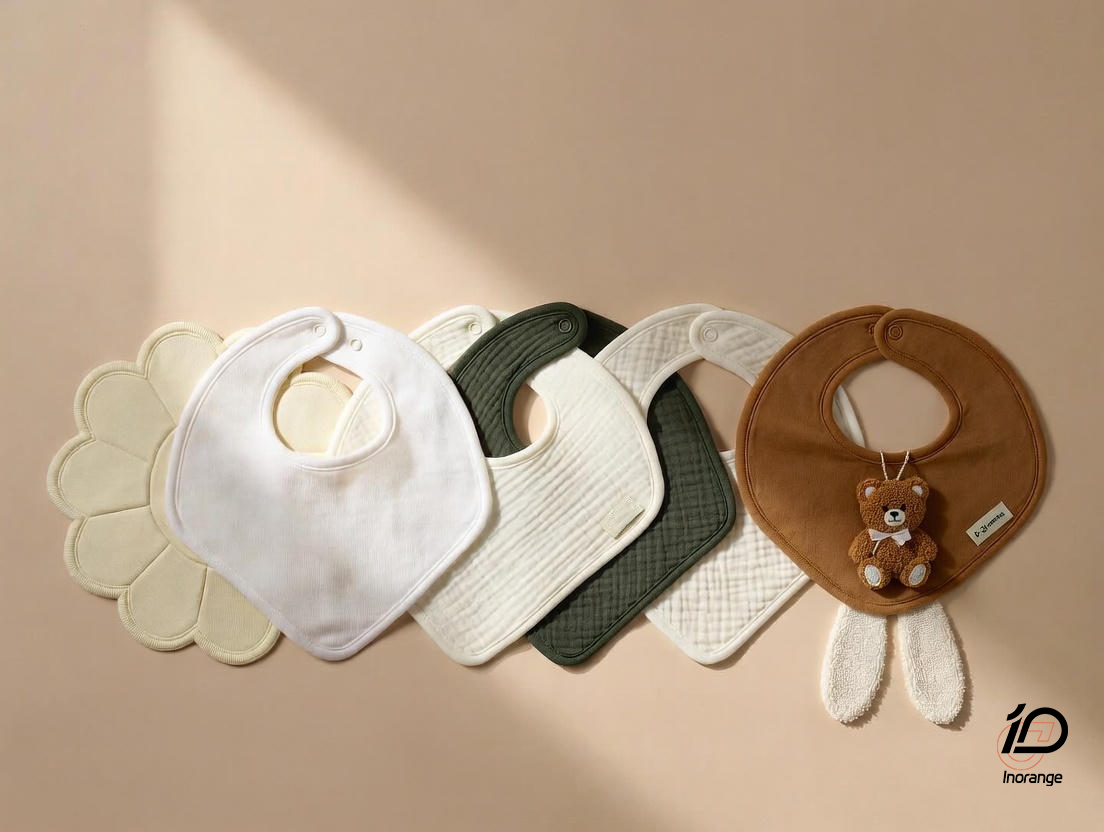
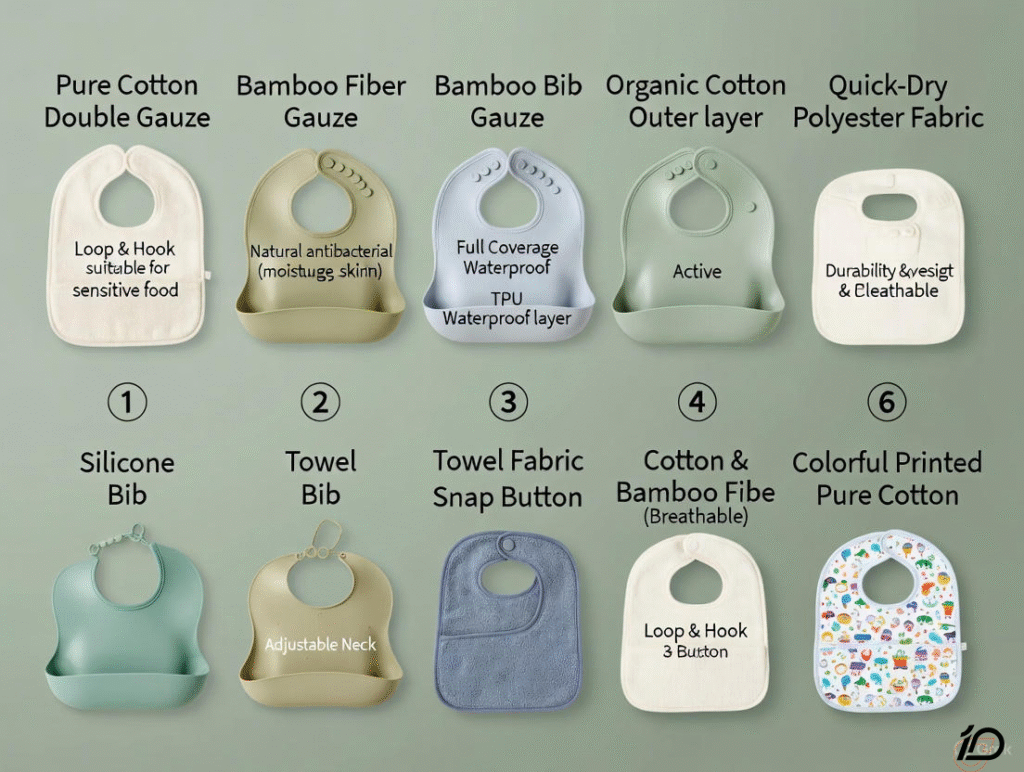
With a dazzling array of bib fabrics on the market, let’s quickly deconstruct the most common “ingredients” you will encounter:
Polyester / Fleece (Synthetic Fibers)
✅ The Pros: Affordable, quick-drying, and often used as a waterproof backing layer.
❌ The Dealbreaker: Extremely poor breathability. While it physically blocks drool, it traps heat and moisture against the skin. This creates a humid environment that encourages bacterial growth and exacerbates skin issues like eczema or heat rash.
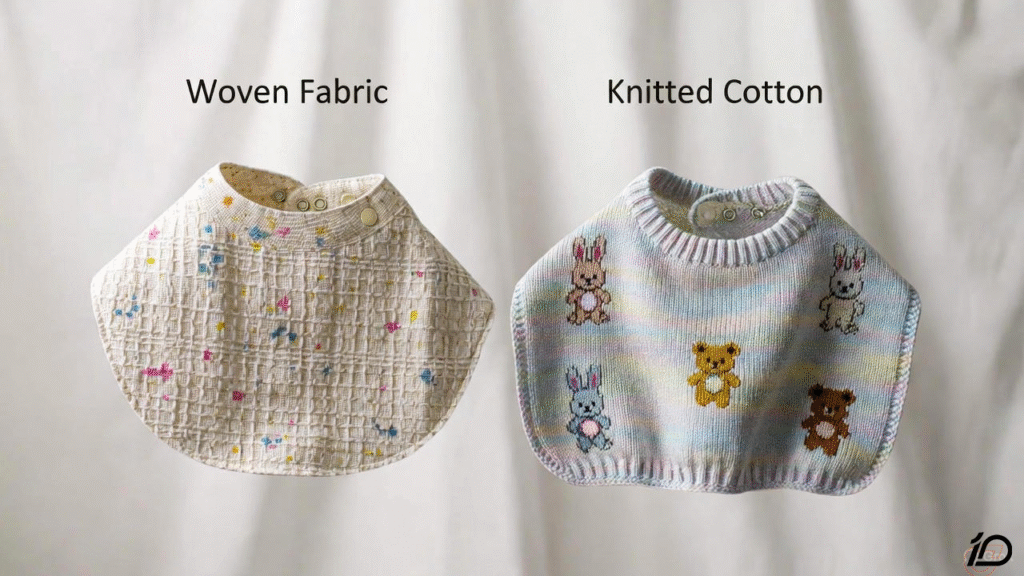
Woven Muslin Cotton
✅ The Pros: Lightweight, highly breathable, and tends to get softer with every wash.
❌ The Dealbreaker: Simply too thin for “Heavy Droolers.” Due to its low density, it has limited total absorption capacity. It becomes saturated quickly and leaks through to the baby’s clothing, forcing parents to change bibs constantly throughout the day.
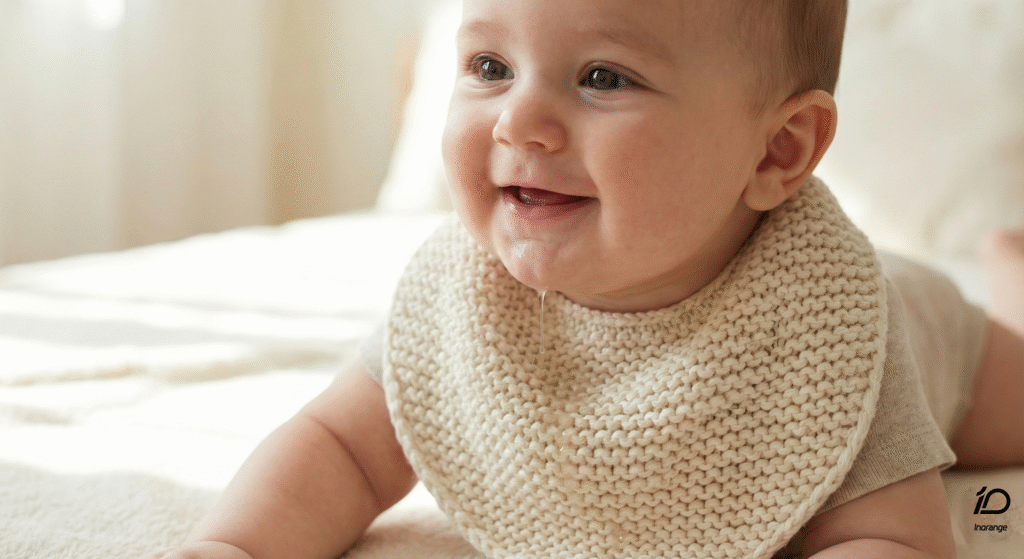
The Star of the Show: 100% Knitted Cotton
- ⭐ Note: Remember this name. We will analyze exactly why this material emerges as the superior solution in the next section.
🔬 A Deep Dive: Why Knitted Cotton is the Scientific Choice
When we combine the inherent quality of 100% pure cotton with the knitting process, a profound chemical reaction occurs. This isn’t just about cotton quality; it’s a question of structural engineering that elevates performance.
The Victory of Structure: The Breathable Loop
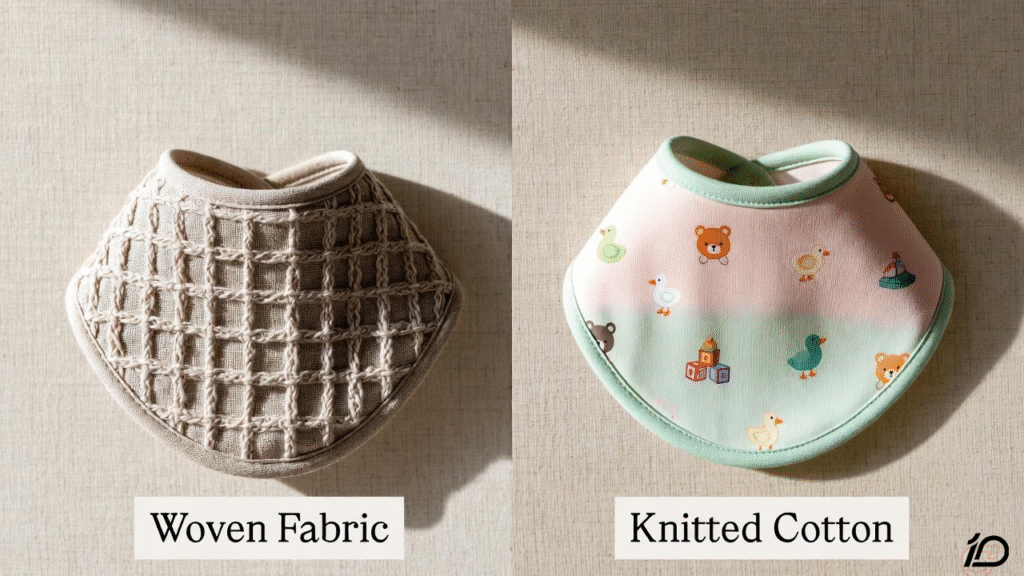
Unlike Woven fabrics (which resemble a tight basket weave), Knitted fabric is formed by yarn bending into interconnected loops.
Skin-Friendly Principle: This unique loop structure gives the fabric natural elasticity and loftiness. Instead of being stiff like woven cloth, it conforms to the baby’s neck curve, minimizing friction and irritation.
Absorption Principle: The loops create countless micro-reservoirs and air pockets. This allows the material to rapidly lock away large volumes of moisture while keeping the surface feeling relatively dry.
Key Performance Indicators: The Secret of GSM and Yarn Count
In the professional textile field, we use two critical metrics to measure the quality of a knitted cotton fabric, directly determining the bib’s performance:
A. GSM (Grams per Square Meter): The Guarantee of Absorbency
GSM represents the weight of the fabric per square meter. Standard market bibs may only be $160g-180g$. However, premium knitted bibs typically exceed $200g$—the industry benchmark being $230g$. Higher GSM means more cotton is used, providing a thicker, more powerful capacity for absorption and retention, effectively preventing moisture from soaking back through (anti-seepage).
B. Yarn Count (or Thread Count): The Core of Softness
A higher yarn count indicates a finer, thinner yarn, resulting in a smoother, more delicate fabric surface. While standard products might use $20s$ or $24s$ yarn, high-end products (such as $32s$ Combed Cotton) deliver a cloud-like touch that is crucial for irritated skin affected by drool rash.
The Victory of Structure: The Breathable Loop
Unlike Woven fabrics (which resemble a tight basket weave), Knitted fabric is formed by yarn bending into interconnected loops.
Skin-Friendly Principle: This unique loop structure gives the fabric natural elasticity and loftiness. Instead of being stiff like woven cloth, it conforms to the baby’s neck curve, minimizing friction and irritation.
Absorption Principle: The loops create countless micro-reservoirs and air pockets. This allows the material to rapidly lock away large volumes of moisture while keeping the surface feeling relatively dry.
🧪 Laboratory Data: Simulated Testing & Research Citations
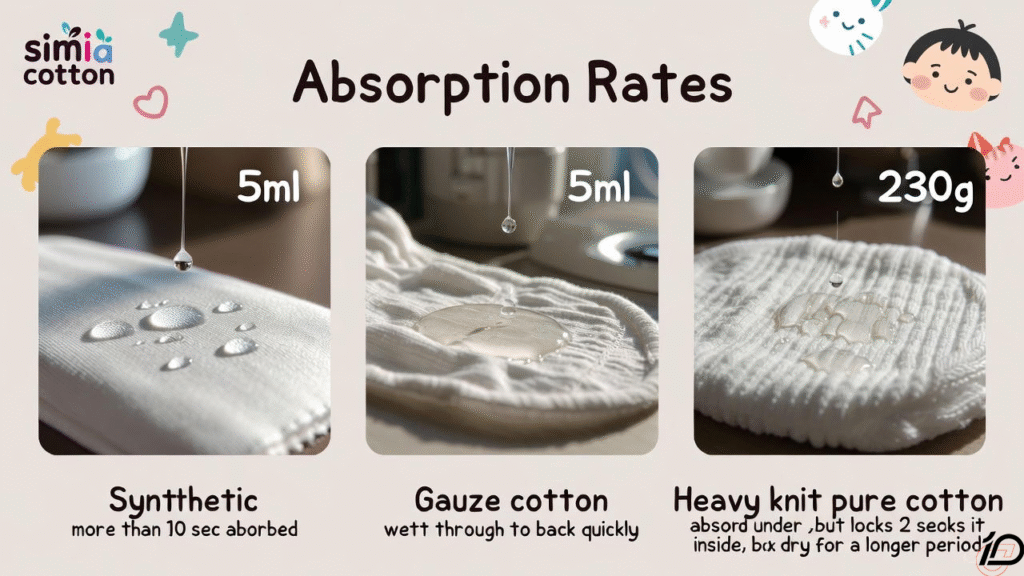
To validate our analysis, we reference testing methodologies commonly used in textile labs (the data below is simulated based on general industry knowledge):
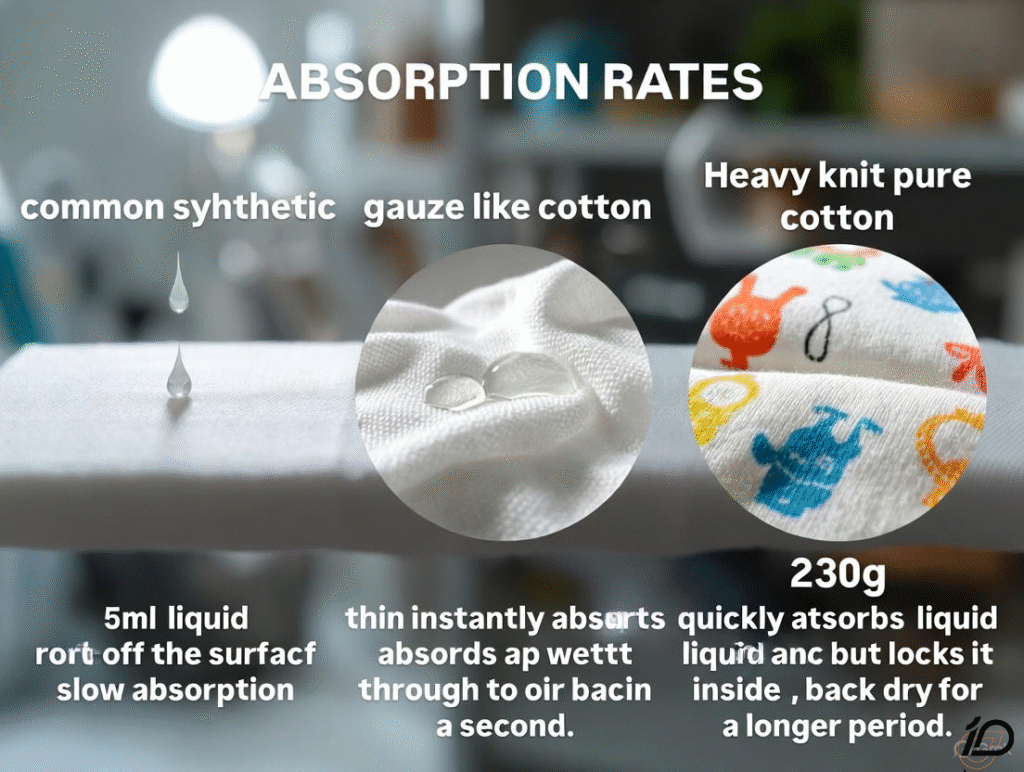
🔬 Lab Simulation: Absorption Rate Test (AATCC 79 Standard Adaptation)
We simulated the time required for complete absorption after dropping 5 ml of liquid onto various fabric types:
| Fabric Type | Observation & Outcome |
| Standard Synthetic Fabric (Fleece/Polyester) | Liquid beads on the surface; absorption is extremely slow ($>10$ seconds). |
| Thin Woven Muslin Cotton | Instantaneous absorption ($<1$ second), but quickly soaks through to the back side. |
| High-GSM Knitted Pure Cotton (230g Class) | Rapid absorption ($<2$ seconds). Liquid is diffused and locked deep within the fabric, keeping the back side dry for a significantly longer period. |
📚 Industry Research Citation
According to findings in the Journal of Textiles and related dermatological studies, maintaining skin dryness and minimizing mechanical friction are key components in the care of Infant Contact Dermatitis (e.g., drool rash).
Research consistently indicates that natural fiber knitted fabrics with high moisture absorption and soft structures are the ideal choice for contact with sensitive skin. This is because they can wick away moisture while simultaneously providing protective cushioning.
🌟 Conclusion: Choosing Fabric Is Choosing Health
From the perspective of 【Ingredient Breakdown】, an exceptional drool bib must achieve the perfect equilibrium between superior absorbency and ultimate skin-friendliness.
While the market offers countless options, both scientific analysis and practical experience consistently point in one direction: the 100% Knitted Pure Cotton fabric with a High GS M (e.g. 230 g) and a High Yarn Count (e.g.32 s). Thanks to its unique loop structure and robust material standards, it delivers comprehensive performance unmatched by other fabrics.
The next time you are selecting a bib for your baby, take a moment to feel its thickness, test its elasticity, and check the ingredient label. Investing in your baby’s health and comfort is always worthwhile.