Trends and Challenges: Summer Heat and Sleep
Global summer temperatures rise every year. Families now prioritize a comfortable sleep environment. Infants are much more sensitive to heat than adults. Their sweat glands are not yet fully efficient. Even minor changes can ruin sleep quality.
Research shows that heat affects sleep structures. This includes shorter sleep and frequent waking [1]. Overheating also increases physiological stress. Safety guidelines recommend avoiding heavy bedding [2]. Experts suggest using breathable materials. The industry is moving toward systematic design.

Why Infants Are More Affected by Temperature
A baby’s regulation system is not fully developed. They cannot adapt to sudden temperature changes. Their body shape makes heat loss difficult. Heat directly affects heart rate and breathing [3].
When too hot, infants wake up often. They experience less deep sleep at night. Sleep cycles become unstable and fragmented. High heat prevents moisture from leaving skin. Sweat stays trapped against their sensitive skin. This decreases their overall comfort and health.
Defining the Summer Infant Sleep System
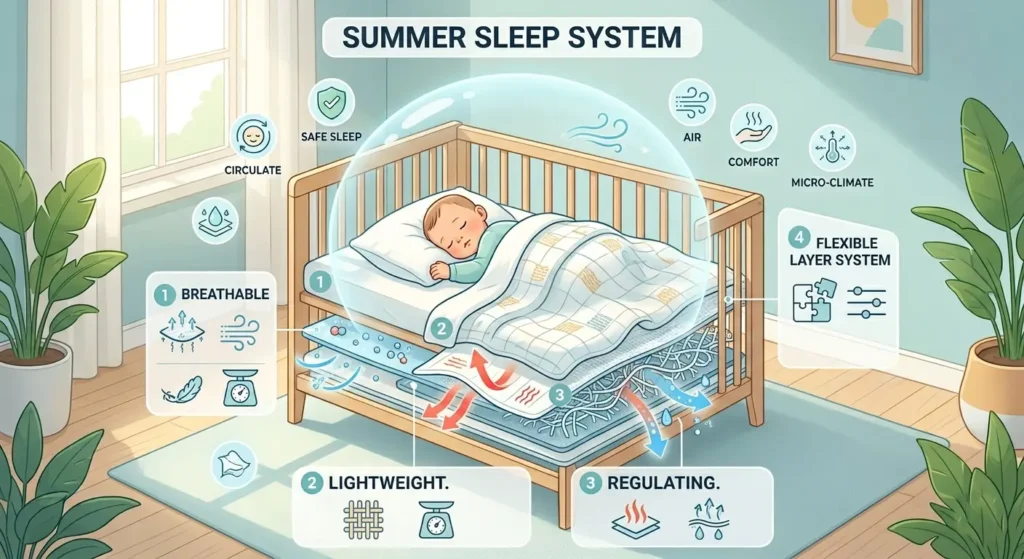
This system is a new industry concept. It is based on safe sleep principles. It focuses on comfort and air circulation. The core idea is to regulate the micro-climate. We use layering instead of thick products [2][4].
A typical sleep system includes:
- Breathable Base Layer: This provides skin comfort and basic airflow. It keeps the baby dry and cool.
- Lightweight Overlays: Muslin or light fabrics prevent overheating. They offer security without the heavy weight.
- Regulation Layers: Fiber structures release heat and evaporate sweat. They maintain a stable temperature all night.
- Flexible Layering: Parents can combine pieces based on room temperature. This offers a versatile solution for any home.
The Popularity of Knitted Fabrics
Knitted fabrics are growing fast in the baby market. This is due to material science and consumer demand. The loop structure creates natural air channels. It balances softness with superior breathability. It provides better ventilation than woven fabrics.
Engineering experts call this “high comfort adaptability” [5]. It conforms to the baby’s shape easily. Key advantages include high softness and skin-friendliness. Natural stretch allows for active movement. Fabrics offer good wicking and air circulation. Lightweight structures are perfect for summer use. There is much less physical restriction.
Consumers now choose function and comfort over decoration. Knitted products are taking a larger market share. Common items include jersey swaddles and cotton knit blankets. Lightweight interlock wraps are also very popular now.

The B2B Buyer’s Perspective: Core Concerns
Summer baby textiles are shifting toward functionality. Buyers focus on performance over looks. Brands want materials with verifiable health benefits. Purchasing managers primarily focus on:
- Breathability and active thermal management.
- GSM weight and seasonal thickness matching.
- Washing durability and long-term shape retention.
- Hypoallergenic and skin-friendly fabric properties.
- International safety compliance like OEKO-TEX.
- Multi-scenario usage for modern urban lifestyles.

Market Trends: Lightweight and Breathable
The global market prefers functional designs. Lightweight blankets are in very high demand. Muslin and knitted materials are growing fast. Layered sleep systems are the mainstream choice.
Neutral and natural colors are the top choice. These colors emphasize calm and responsibility. The industry is shifting toward systematic solutions. It is not just about single products. Factories now offer complete sleep packages.